Your website might be beautifully designed and packed with valuable content, but if it’s not properly optimized for search engines, potential customers will never find it. The good news? On-page SEO remains one of the most controllable and cost-effective ways to improve your Google rankings in 2026, and you don’t need a computer science degree to make it work.
For small business owners across South Florida, mastering on-page SEO fundamentals can mean the difference between being buried on page five of Google results and appearing right where your customers are looking. Let’s break down exactly how to use on-page search engine optimization to drive more qualified traffic to your website this year.
What Is On-Page SEO and Why Does It Matter More Than Ever?
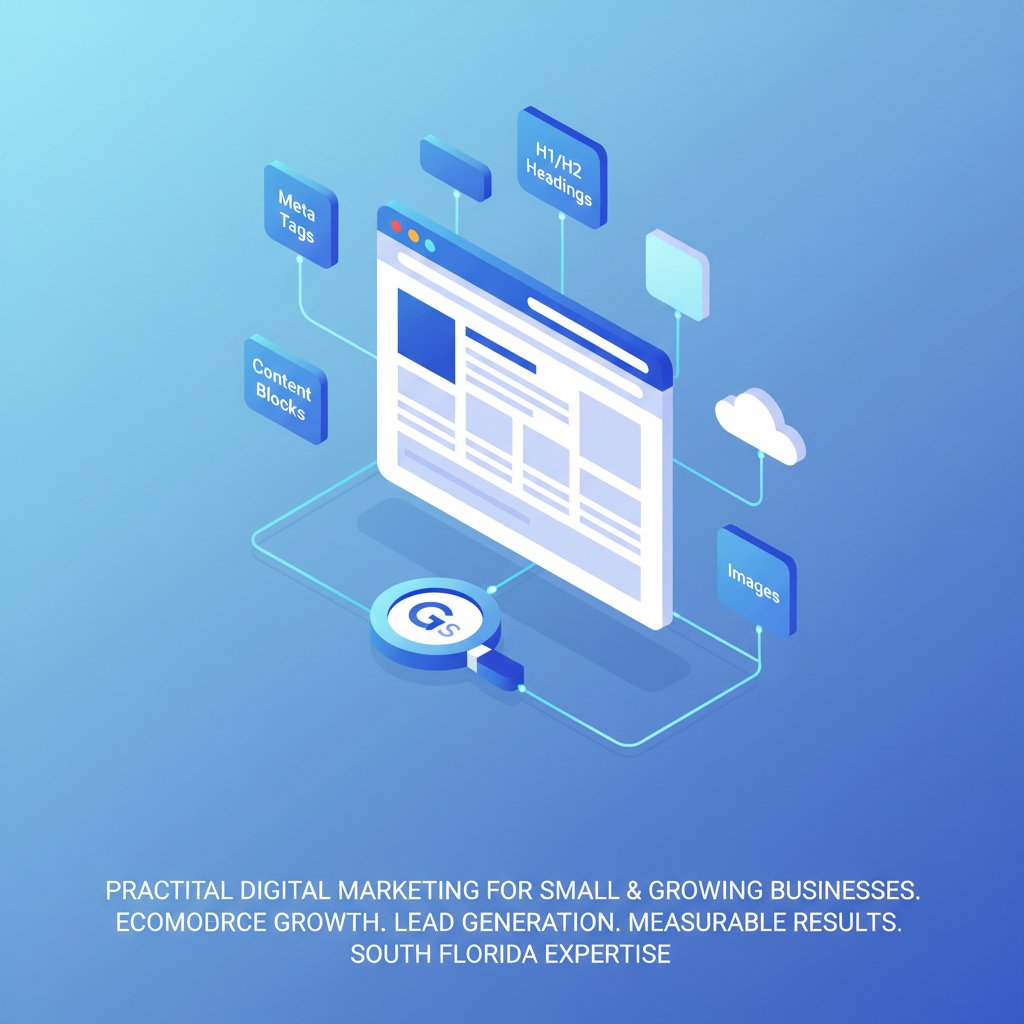
On-page SEO refers to all the optimization tactics you can implement directly on your website to improve its search engine rankings. Unlike off-page SEO, which involves backlinks and external signals, on-page SEO gives you complete control over the elements that help Google understand and rank your content.
In 2026, Google’s AI-powered search algorithms have become incredibly sophisticated at understanding user intent and content quality. The search giant’s latest updates prioritize websites that provide genuine value, clear organization, and excellent user experience. This shift actually benefits small businesses willing to invest time in proper on-page optimization.
Consider this real-world example: A family-owned HVAC company in Fort Lauderdale came to us ranking on page three for “air conditioning repair Fort Lauderdale.” After implementing comprehensive on-page SEO improvements—including optimized title tags, improved content structure, and strategic keyword placement—they jumped to position four within six weeks. That translated to 247% more website visitors and 83 additional service calls in their first quarter.
The Foundation: Keyword Research Services That Actually Work
Before you optimize anything, you need to know what your customers are actually searching for. Small business SEO starts with understanding the specific phrases your target audience uses when looking for products or services like yours.
Gone are the days of simply targeting “Miami restaurant” or “Boca Raton lawyer.” In 2026, successful keyword research services focus on search intent and long-tail keywords that capture customers at different stages of their buying journey.
How to Identify Your Best Keywords
- Start with customer conversations: What questions do your customers ask? What problems are they trying to solve? These real conversations reveal valuable keyword opportunities.
- Analyze competitor rankings: Look at what keywords your successful competitors rank for, then identify gaps you can fill.
- Use modern keyword tools: Platforms like Semrush, Ahrefs, and Google’s Keyword Planner provide search volume data and competition levels.
- Focus on local intent: For South Florida businesses, incorporating geographic modifiers like neighborhood names or “near me” variations is crucial.
- Balance difficulty and opportunity: Target a mix of competitive short-tail keywords and achievable long-tail phrases.
A Delray Beach boutique we worked with discovered that while “women’s clothing” was too competitive, “sustainable women’s clothing Delray Beach” had lower competition and attracted highly motivated buyers. By optimizing their product pages for these specific phrases, they increased organic traffic by 156% in four months.
Title Tags and Meta Descriptions: Your First Impression
Your title tag is the clickable headline that appears in search results, and it’s one of the most important on-page SEO elements. In 2026, Google has become even more particular about title tag relevance and user engagement.
Crafting Effective Title Tags
Keep your title tags between 50-60 characters to avoid truncation in search results. Include your primary keyword near the beginning, and make sure each page has a unique title that accurately describes its content. Most importantly, write for humans first—your title should entice clicks while clearly communicating what visitors will find.
For example, instead of “Services – ABC Plumbing,” use “Emergency Plumber Miami | 24/7 Leak Repair & Installation.” This title includes location, urgency, and specific services while staying within character limits.
Meta descriptions don’t directly impact rankings, but they significantly influence click-through rates. Write compelling 150-160 character summaries that include your target keyword and a clear benefit or call-to-action. Think of your meta description as ad copy that sells the click.
Content Optimization: Quality Meets Strategy
The heart of on-page SEO is your actual content. Google’s algorithms in 2026 are remarkably good at distinguishing between thin, keyword-stuffed content and genuinely helpful information that serves user needs.
Creating SEO-Optimized Content
Start with comprehensive topic coverage. Rather than writing a 300-word page that barely scratches the surface, create thorough content that answers related questions and provides real value. This doesn’t mean every page needs to be 2,000 words, but it should fully address the topic at hand.
Incorporate your target keywords naturally throughout the content, especially in the first paragraph, at least one H2 heading, and naturally throughout the body text. However, keyword density is far less important than topical relevance and readability. Write for humans, not robots.
Use semantic keywords and related phrases. Google’s understanding of language means it recognizes that “automobile,” “car,” and “vehicle” are related terms. Natural writing that covers a topic comprehensively will automatically include these variations.
The Power of Proper Formatting
Structure your content with clear headings (H1, H2, H3) that organize information logically. Your H1 should be your main headline—use only one per page. H2 tags divide your content into major sections, while H3 tags create subsections within those.
Break up long paragraphs into easily scannable chunks. Use bullet points and numbered lists to present information clearly. Add bold text to emphasize important points. All of these formatting elements improve user experience and help search engines understand your content hierarchy.
Technical On-Page Elements That Impact Rankings
Beyond content, several technical elements significantly influence your google ranking optimization efforts.
URL Structure
Keep URLs short, descriptive, and keyword-rich. Use hyphens to separate words, avoid unnecessary parameters, and create a logical hierarchy. For example, “yourbusiness.com/services/ac-repair-miami” is far better than “yourbusiness.com/page?id=12345”.
Header Tags Hierarchy
Maintain a logical heading structure throughout your pages. Never skip heading levels (don’t jump from H2 to H4), and ensure your headings accurately describe the content that follows. This hierarchy helps both users and search engines navigate your content.
Image Optimization
Every image should include descriptive alt text that serves two purposes: accessibility for visually impaired users and context for search engines. Compress images to reduce file size without sacrificing quality, as page speed remains a critical ranking factor. Use descriptive file names rather than “IMG_1234.jpg”.
Internal Linking Strategy
Link to other relevant pages on your website using descriptive anchor text. This helps distribute page authority throughout your site and keeps visitors engaged longer. A well-planned internal linking structure can significantly improve how search engines crawl and understand your site architecture.
Mobile Optimization and Page Speed
With Google’s mobile-first indexing fully implemented, your website’s mobile experience directly determines your rankings. In South Florida’s mobile-heavy market, this is particularly critical—over 68% of local searches happen on mobile devices.
Ensure your website uses responsive design that adapts seamlessly to different screen sizes. Test your pages on actual mobile devices, not just desktop browsers. Check that buttons are easy to tap, text is readable without zooming, and navigation is intuitive on smaller screens.
Page speed has become even more important in 2026. Google’s Core Web Vitals—metrics measuring loading performance, interactivity, and visual stability—directly impact rankings. Use tools like Google PageSpeed Insights to identify specific issues slowing down your site.
Common page speed improvements include compressing images, minimizing CSS and JavaScript files, leveraging browser caching, and using a content delivery network (CDN). An SEO agency South Florida businesses trust can help implement these technical improvements if they feel overwhelming.
Schema Markup and Rich Snippets
Schema markup is code you add to your website that helps search engines understand your content better and can result in enhanced search listings with rich snippets. These eye-catching results include elements like star ratings, pricing, availability, and other details that make your listing stand out.
For local businesses, implementing LocalBusiness schema, Product schema for e-commerce items, FAQ schema, and Review schema can significantly improve click-through rates. While schema doesn’t directly boost rankings, the increased engagement it generates sends positive signals to Google.
Monitoring Your On-Page SEO Success
On-page SEO isn’t a one-time project—it requires ongoing monitoring and adjustment. Set up Google Search Console to track how your pages perform in search results, identify technical issues, and see which queries drive traffic to your site.
Track your rankings for target keywords monthly, but focus more on overall organic traffic trends and conversion rates. A drop in rankings for one keyword matters less if your overall qualified traffic is increasing.
Monitor user engagement metrics like bounce rate, time on page, and pages per session. If visitors quickly leave your site, Google interprets this as a signal that your content didn’t meet their needs, which can hurt rankings over time.
Common On-Page SEO Mistakes to Avoid
Even with good intentions, businesses often make on-page SEO mistakes that hurt their rankings. Avoid duplicate content across multiple pages—each page should have unique, valuable content. Don’t over-optimize by cramming keywords unnaturally into every sentence. Never hide text or links to manipulate rankings, as Google penalizes these black-hat tactics.
Also, resist the urge to optimize for search engines at the expense of user experience. If your page is difficult to read, navigate, or use, visitors will leave—and rankings will eventually suffer.
Working With Professional SEO Support
While many on-page SEO tasks are manageable for motivated business owners, the complexity and time commitment can be overwhelming when you’re also running a business. That’s where partnering with an experienced SEO agency South Florida businesses rely on can accelerate your results.
Professional keyword research services uncover opportunities you might miss on your own. Expert optimization ensures every technical element is properly configured. Ongoing monitoring and adjustment keep your strategy aligned with Google’s evolving algorithms.
The key is finding a partner who provides personal attention and explains strategies in plain language rather than hiding behind jargon. Your SEO agency should feel like an extension of your team, focused on measurable results that impact your bottom line.
Take Control of Your Rankings Today
On-page SEO gives you direct control over how search engines understand and rank your website. By implementing the strategies outlined here—from thorough keyword research to technical optimization—you can significantly improve your visibility in search results and attract more qualified customers.
Remember, effective small business SEO is a marathon, not a sprint. Start with the fundamentals, implement changes systematically, and monitor your results. The businesses that consistently invest in on-page optimization are the ones that dominate local search results year after year.
Ready to take your website’s search performance to the next level? UltraWeb Marketing specializes in helping South Florida businesses implement proven on-page SEO strategies that deliver measurable results. Our team combines technical expertise with a personal approach, ensuring you understand exactly how our work drives more customers to your business. Contact us today for a comprehensive website SEO audit and discover the specific opportunities waiting to boost your rankings.
Frequently Asked Questions
How long does it take to see results from on-page SEO?
Most businesses start seeing measurable improvements within 4-8 weeks of implementing on-page SEO changes, though significant ranking gains typically take 3-6 months. The timeline depends on your website’s current state, competition level, and how comprehensively you optimize. Quick wins like fixing title tags and improving page speed can show results faster than broader content optimization efforts.
Can I do on-page SEO myself or do I need to hire an agency?
Many on-page SEO tasks are definitely manageable for business owners willing to learn the fundamentals. Basic optimizations like improving title tags, writing better content, and optimizing images can be done without technical expertise. However, more complex elements like schema markup, technical site architecture, and comprehensive keyword research often benefit from professional help. Consider starting with DIY efforts and consulting professionals for areas that feel overwhelming.
What’s the most important on-page SEO factor in 2026?
While no single factor guarantees rankings, high-quality, comprehensive content that genuinely answers user questions remains the most critical element. Google’s AI algorithms prioritize content that demonstrates expertise and provides real value. Combined with proper technical optimization, mobile-friendliness, and fast page speed, quality content forms the foundation of successful on-page SEO.
How often should I update my on-page SEO?
Review and update your most important pages quarterly to ensure content remains current and accurate. Monitor your rankings monthly and adjust strategies based on performance data. When Google releases major algorithm updates or when your business offerings change, update relevant pages promptly. On-page SEO is an ongoing process rather than a one-time task.
Does on-page SEO work for local businesses?
Absolutely. On-page SEO is especially effective for local businesses when combined with location-specific optimization. Including your service area in title tags, creating location-specific content, and implementing LocalBusiness schema markup helps you rank for valuable “near me” and local searches. For South Florida businesses, proper on-page optimization is essential for capturing the growing mobile-local search market.