Your phone should be ringing more. If you’re a South Florida service business owner—whether you run an HVAC company, plumbing service, legal practice, or home repair business—every day without enough service calls is lost revenue. The good news? Google Ads search campaigns remain the fastest way to connect with customers actively searching for your services in 2026.
Unlike social media advertising where you’re interrupting people’s scrolling, search advertising services put your business in front of potential customers at the exact moment they’re typing “emergency plumber near me” or “AC repair Boca Raton” into Google. That intent-driven targeting is why businesses using pay per click advertising typically see a return of $2 for every $1 spent, according to Google’s 2026 economic impact report.
Let’s walk through exactly how to structure Google Ads search campaigns that generate qualified service calls, not just clicks that waste your budget.
Why Google Ads Search Campaigns Work for Service Businesses
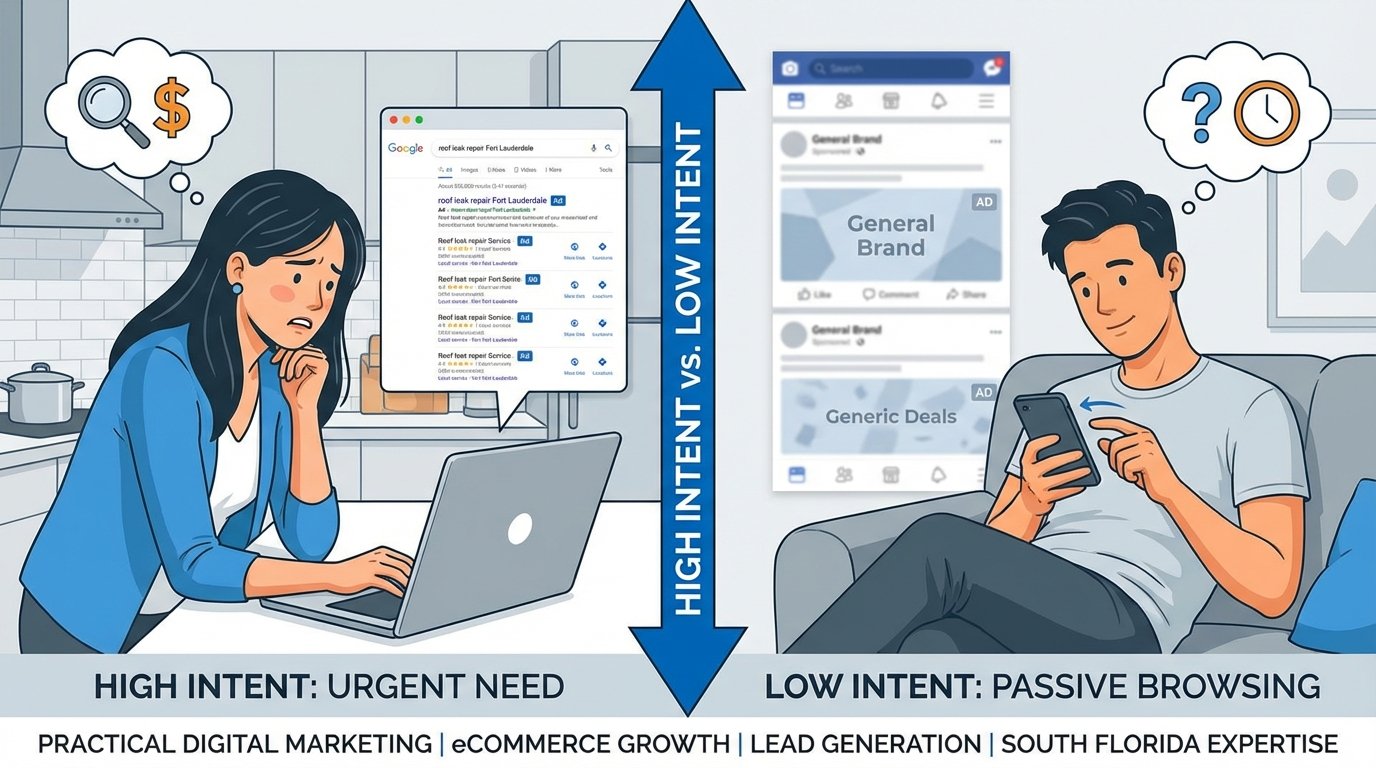
Search campaigns target high-intent customers. When someone searches “roof leak repair Fort Lauderdale,” they have an immediate need. They’re not browsing—they’re ready to hire. This is fundamentally different from brand awareness advertising.
A local Miami electrician we worked with was spending $1,200 monthly on traditional directory listings with minimal results. After switching to a properly managed Google Ads search campaign with a $1,500 monthly budget, they generated 47 qualified service calls in the first month alone, converting 19 into jobs worth over $23,000 in revenue.
The power lies in three factors:
- Timing: You reach customers when they’re actively searching for solutions
- Targeting: Geographic and keyword filters ensure only relevant prospects see your ads
- Measurability: Track every call, form submission, and dollar spent with precision
Setting Up Your Campaign Structure for Maximum Calls
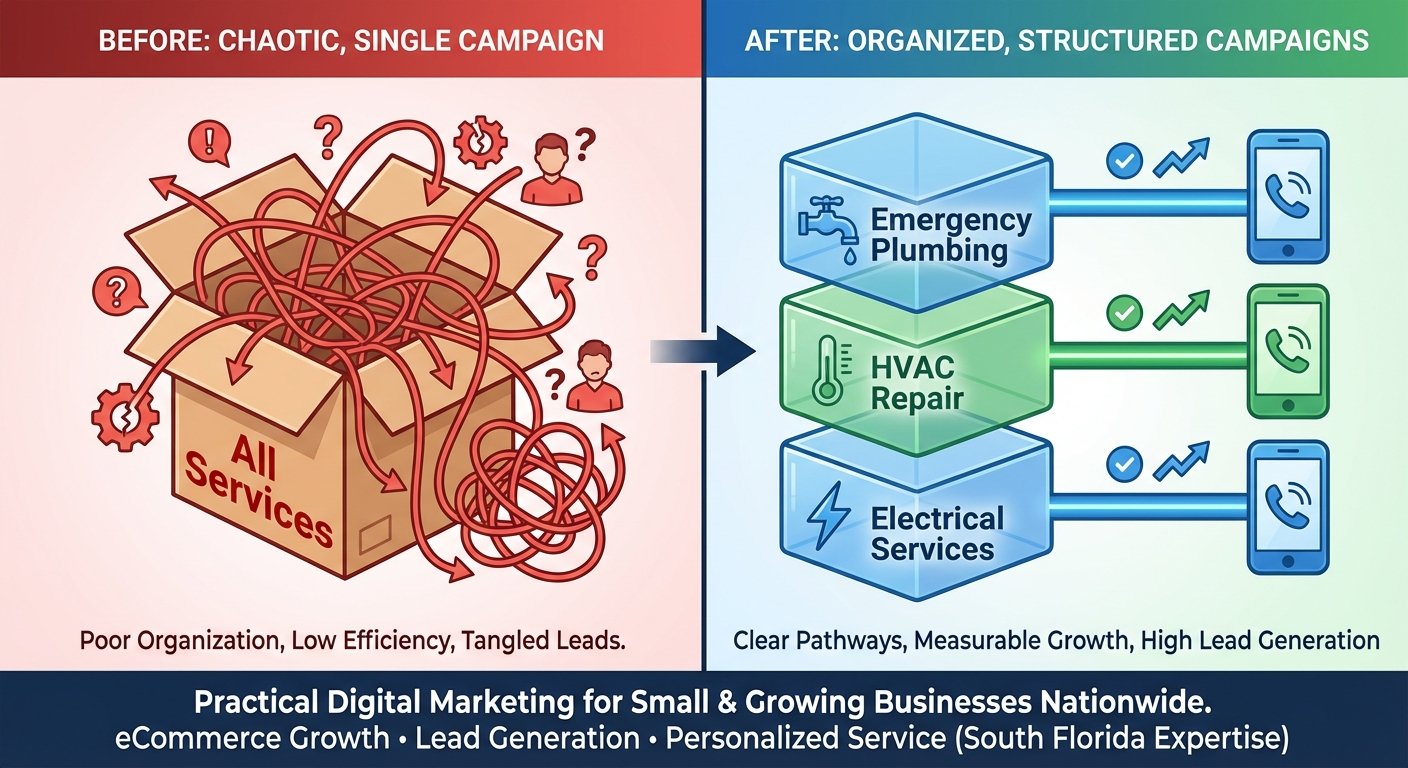
The biggest mistake service businesses make is creating one campaign with all their services lumped together. A google ads specialist will tell you that campaign structure directly impacts performance and cost-efficiency.
Create Service-Specific Campaigns
Separate your services into distinct campaigns. If you offer plumbing, drain cleaning, and water heater installation, create three campaigns. Why? Different services have different profit margins, search volumes, and conversion rates. You need flexibility to allocate budget where it performs best.
For each campaign, build tightly themed ad groups. Your “emergency plumbing” ad group should contain only emergency-related keywords like “24 hour plumber,” “emergency plumbing service,” and “urgent plumbing repair.” This tight relevance improves your Quality Score, lowering your cost per click.
Target the Right Geographic Areas
Don’t waste ad spend on clicks from areas you don’t service. If you serve Palm Beach County but not Broward, geo-targeting prevents paying for irrelevant clicks. In 2026, Google’s location targeting has become more sophisticated, allowing radius targeting around multiple service areas simultaneously.
A West Palm Beach HVAC company increased their conversion rate by 34% simply by excluding zip codes more than 25 miles from their location and increasing bids by 20% for their immediate service area where they could respond fastest.
Keyword Strategy That Drives Service Calls
Keywords are the foundation of search campaigns. The right keyword strategy means the difference between your budget generating calls or evaporating on tire-kickers.
Focus on Commercial Intent Keywords
Not all keywords convert equally. Someone searching “how to fix a leaky faucet” wants DIY information. Someone searching “plumber to fix leaky faucet Delray Beach” wants to hire someone now.
Prioritize keywords with commercial and transactional intent:
- Service + location (“electrician Coral Springs”)
- Emergency terms (“emergency AC repair,” “same day service”)
- Specific solutions (“water heater replacement,” “panel upgrade”)
- Hiring language (“hire,” “cost,” “near me,” “best”)
Use Negative Keywords Aggressively
Negative keywords prevent your ads from showing for irrelevant searches. Add terms like “DIY,” “how to,” “jobs,” “salary,” “free,” and “cheap” to your negative keyword list. A google ads consultant can identify hundreds of negative keywords specific to your industry that prevent wasted spend.
One Fort Lauderdale locksmith reduced their cost per conversion by 41% after implementing a comprehensive negative keyword list that filtered out job seekers, DIY researchers, and bargain hunters who rarely converted.
Writing Ad Copy That Generates Clicks and Calls
Your ad copy has roughly three seconds to convince someone to click your ad instead of your competitors’. In 2026, with Google’s expanded text ads and responsive search ads dominating, you have more flexibility but also more competition.
Highlight What Makes You Different
Generic ad copy gets ignored. “Professional Plumbing Services” doesn’t differentiate you. Instead, emphasize:
- Response time (“30-Minute Response Time”)
- Availability (“24/7 Emergency Service”)
- Credentials (“Licensed & Insured Since 1998”)
- Guarantees (“100% Satisfaction Guarantee”)
- Service area specificity (“Serving Boca Raton for 15 Years”)
Include Strong Calls-to-Action
Tell people exactly what to do: “Call Now for Same-Day Service,” “Book Your Free Estimate Today,” or “Get 24/7 Emergency Help.” Include your phone number in ad extensions so mobile users can tap to call directly from search results.
Test Multiple Ad Variations
Google’s responsive search ads allow up to 15 headlines and 4 descriptions. Use them all. Test emotional appeals against logical ones. Try urgency-focused messaging against value-focused messaging. A ppc management services provider continuously tests and optimizes ad variations to improve performance over time.
Optimizing for Phone Calls, Not Just Clicks
Clicks mean nothing if they don’t generate calls and conversions. In 2026, call tracking and conversion optimization are more accessible than ever for small businesses.
Implement Call Tracking
Use Google’s call extensions and call-only campaigns for mobile users. Implement dynamic number insertion on your landing pages so you know exactly which keywords and ads generate calls. This data allows you to increase bids on high-performing keywords and pause underperformers.
Optimize Your Landing Pages
Sending traffic to your homepage is a mistake. Create dedicated landing pages for each service campaign that match the ad messaging. If your ad promises “Same-Day AC Repair in Miami,” your landing page headline should echo that promise.
Essential landing page elements for service businesses include:
- Click-to-call phone number prominently displayed
- Simple contact form (name, phone, service needed—that’s it)
- Service area clearly stated
- Trust signals (reviews, certifications, years in business)
- Clear explanation of what happens when they call
A Pompano Beach restoration company increased their conversion rate from 12% to 28% by simplifying their landing page and adding a prominent “Call Now” button above the fold.
Budget Management and Bid Strategies
Budget mismanagement kills otherwise good campaigns. Service businesses often start with limited budgets, making every dollar critical.
Start Conservative, Scale What Works
Begin with a modest daily budget—perhaps $50 to $100—across your highest-priority service campaign. Monitor performance for two weeks. Once you identify profitable keywords and ad combinations, gradually increase budget to capture more volume.
Use Smart Bidding for Calls
Google’s automated bidding strategies have improved dramatically. The “Maximize Conversions” and “Target CPA” strategies use machine learning to optimize bids for conversion likelihood. For service businesses focused on calls, these strategies often outperform manual bidding after accumulating sufficient conversion data.
Adjust Bids by Time and Device
When do your best customers call? If you’re a commercial locksmith, business hours might convert best. If you’re emergency restoration, after-hours searches might be most valuable. Increase bids during high-conversion times and decrease them during low-conversion periods.
Similarly, mobile searches often have higher intent for service businesses. Someone searching on mobile for “plumber near me” likely has an immediate need. Consider increasing mobile bids by 20-30%.
Integrating Search Ads with Your Broader Marketing
Google Ads search campaigns work best when integrated with your other marketing efforts, particularly local seo services. When your organic presence is strong, your paid ads receive higher click-through rates due to brand familiarity.
A comprehensive lead generation strategy combines:
- Google Ads search campaigns for immediate visibility
- Local SEO to build long-term organic rankings
- Google Business Profile optimization for map pack visibility
- Review generation to strengthen trust signals
- Retargeting campaigns to recapture lost visitors
When these elements work together, the whole exceeds the sum of parts. Prospects who see your organic listing, your Google Ad, and your map listing simultaneously perceive you as the dominant provider in your market.
Measuring What Matters: Beyond Clicks to Revenue
Vanity metrics like impressions and clicks don’t pay bills. Focus on metrics that directly impact revenue.
Track These Key Performance Indicators
- Cost Per Call: Total ad spend divided by phone calls received
- Conversion Rate: Percentage of clicks that become calls or form submissions
- Cost Per Acquisition: Ad spend divided by new customers acquired
- Return on Ad Spend: Revenue generated divided by ad spend
- Quality Score: Google’s rating of your ad relevance (higher scores lower costs)
A professional google ads management service provides detailed monthly reports showing not just campaign metrics but actual business impact—how many calls converted to jobs and the revenue generated.
Common Mistakes Service Businesses Must Avoid
After managing hundreds of service business campaigns across South Florida, we’ve seen recurring mistakes that waste budgets:
- Setting and forgetting: Successful campaigns require ongoing optimization, not quarterly check-ins
- Ignoring search terms reports: This report shows actual searches triggering your ads—goldmine data for optimization
- Bidding on brand terms only: While defending your brand name is important, growth comes from capturing new customer searches
- Not answering the phone: Sounds obvious, but missed calls kill ROI. Have a system to handle calls during business hours and after
- Sending all traffic to your homepage: Service-specific landing pages convert 3-5x better
Partner with Experts Who Understand Service Businesses
Managing Google Ads effectively requires constant attention, testing, and optimization. For busy service business owners, partnering with a google ads specialist who understands your industry and local market makes the difference between campaigns that drain budgets and campaigns that fill your schedule.
At UltraWeb Marketing, we’ve helped South Florida service businesses transform their lead generation through strategic Google Ads management. We understand the unique challenges of service businesses—seasonal fluctuations, emergency calls, service area limitations, and the need for fast ROI.
Our approach combines technical expertise with local market knowledge. We don’t just set up campaigns; we become an extension of your team, continuously optimizing to ensure every advertising dollar works harder for your business.
Ready to stop wondering where your next service call will come from? Let’s build a Google Ads search campaign that keeps your calendar full and your phone ringing. Contact UltraWeb Marketing today for a free consultation and discover how strategic pay per click advertising can transform your service business in 2026.
Frequently Asked Questions
How much should I budget for Google Ads as a service business?
Most service businesses see results with $1,000-$3,000 monthly ad spend, though competitive markets like legal services may require more. Start with what’s comfortable, track your cost per acquisition, and scale budget to profitable campaigns. The key is ensuring each customer acquired costs less than their lifetime value.
How quickly will I see results from Google Ads search campaigns?
Unlike SEO which takes months, Google Ads can generate calls within hours of launching. However, optimal performance requires 2-4 weeks of data collection and optimization. Most service businesses see consistent, profitable results within 30-60 days when campaigns are properly managed.
Should I hire a Google Ads consultant or manage campaigns myself?
DIY management is possible but time-intensive and requires significant learning. Most service business owners find their time is better spent running their business while a specialist handles campaign optimization. A skilled google ads consultant typically generates enough additional revenue to cover their fees many times over.
What’s the difference between Google Ads and local SEO services?
Google Ads provides immediate visibility through paid placement, while local SEO builds organic rankings over time. Ads offer instant results but require ongoing spending; SEO takes longer to develop but provides lasting value. The most successful service businesses invest in both for comprehensive market coverage.
How do I know if my Google Ads campaigns are actually profitable?
Track calls generated, conversion rate to jobs, and revenue per customer. Calculate your cost per acquisition and compare it to customer lifetime value. If acquiring a customer costs $200 but they’re worth $2,000, your campaigns are profitable. Professional ppc management services provide detailed ROI reporting to track these metrics accurately.