Display advertising has evolved dramatically in 2026, and for e-commerce store owners, Google Ads Display Campaigns represent one of the most powerful tools for reaching customers across the web. While Search campaigns capture high-intent shoppers actively looking for products, Display campaigns build awareness, re-engage visitors, and drive conversions at scale. For South Florida e-commerce businesses competing in an increasingly crowded digital marketplace, mastering Display campaigns can mean the difference between stagnant sales and exponential growth.
The challenge? Most business owners feel overwhelmed by the complexity of display advertising management. Between audience targeting options, creative requirements, bidding strategies, and performance metrics, it’s easy to waste thousands of dollars on campaigns that don’t deliver results. This guide breaks down exactly how to use Google Ads Display Campaigns effectively in 2026, with practical strategies you can implement immediately.
Why Display Campaigns Matter for E-commerce Growth
Display campaigns reach over 90% of internet users worldwide through Google’s Display Network, which includes millions of websites, apps, and Google-owned properties like YouTube and Gmail. For e-commerce stores, this creates three critical opportunities:
Brand Awareness: Most consumers need multiple touchpoints before purchasing. Display ads keep your store top-of-mind as potential customers browse content related to your products. A Miami-based fashion retailer we worked with increased brand recall by 68% within three months of launching their first Display campaign, directly correlating with a 34% increase in direct traffic to their online store.
Remarketing Power: On average, 97% of first-time visitors leave e-commerce sites without purchasing. Display remarketing brings these visitors back by showing targeted ads as they continue browsing the web. This isn’t just theory—our South Florida clients consistently see remarketing campaigns deliver 3-5X higher conversion rates than prospecting campaigns.
Cost-Effective Reach: While pay per click advertising on Search campaigns can be expensive in competitive niches, Display campaigns typically offer lower cost-per-click and cost-per-acquisition, making them ideal for businesses with limited budgets who still need significant reach.
Setting Up Your Display Campaign Foundation
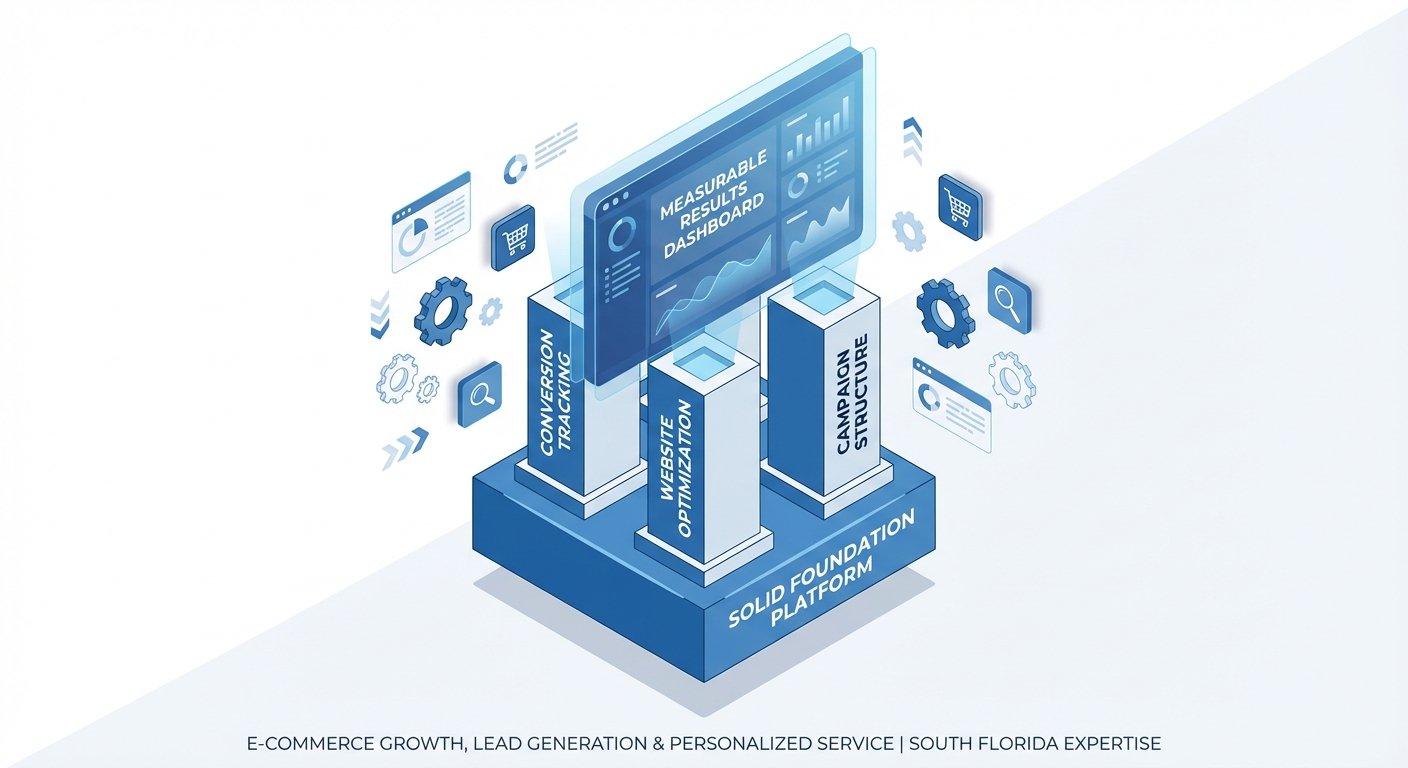
Before launching campaigns, your foundation must be solid. We’ve seen too many e-commerce businesses rush into Display advertising only to discover their tracking is broken or their website isn’t optimized for conversions.
Ensure Proper Conversion Tracking
In 2026, accurate conversion tracking is non-negotiable. Google’s enhanced conversion tracking now uses first-party data and AI-powered modeling to track conversions even when cookies are blocked. Set up tracking for these key actions:
- Purchase completions (your primary conversion)
- Add-to-cart actions
- Begin checkout events
- Newsletter signups
- Product page views for high-value items
If you’re working with a google advertising agency, they should verify that your tracking fires correctly across all devices and browsers. Without accurate data, you’re flying blind.
Optimize Your Website Experience
Display campaigns drive traffic, but your ecommerce web design determines whether that traffic converts. In 2026, mobile optimization is especially critical—over 73% of e-commerce traffic comes from mobile devices. Key elements to audit:
- Page load speed under 2.5 seconds
- Clear product images with zoom functionality
- Streamlined checkout process (ideally under three steps)
- Trust signals like customer reviews and secure payment badges
- Exit-intent popups offering incentives to hesitant visitors
A Fort Lauderdale home goods store we partnered with saw their Display campaign conversion rate jump from 1.2% to 3.8% after optimizing their mobile checkout flow—no changes to the ads themselves, just better ecommerce website development practices.
Building High-Performance Display Campaigns
Google’s AI has become remarkably sophisticated in 2026, but success still requires strategic setup and human oversight.
Campaign Structure Best Practices
Start with separate campaigns for prospecting and remarketing. These audiences have different intent levels and require different messaging and bidding strategies. Within prospecting, consider segmenting by:
- In-market audiences: Users actively researching products in your category
- Affinity audiences: Users with long-term interests aligned with your products
- Custom audiences: Users who visited websites, used apps, or searched terms related to your products
- Optimized targeting: Allowing Google’s AI to expand beyond your selected audiences when it identifies conversion opportunities
For remarketing, segment by engagement level. Someone who viewed three product pages is warmer than someone who only visited your homepage, and your ad creative should reflect that difference.
Creative That Converts
In 2026, responsive display ads remain the standard, automatically adjusting size, appearance, and format to fit available ad spaces. However, simply uploading random images won’t cut it. High-performing creative includes:
- Clear product focus: Show what you’re selling prominently
- Value proposition: Communicate your unique advantage in five words or less
- Compelling call-to-action: “Shop Now” and “Limited Time” consistently outperform generic CTAs
- Brand consistency: Use colors, fonts, and style matching your online store development
- Multiple variations: Upload 5-10 images and 5 headlines to let Google’s AI find winning combinations
A West Palm Beach electronics retailer tested two creative approaches: generic lifestyle images versus product-focused ads with clear pricing. The product-focused ads delivered 2.4X more conversions at 31% lower cost-per-acquisition.
Smart Bidding for E-commerce
Manual bidding is essentially obsolete in 2026. Google’s AI-powered Smart Bidding strategies process millions of signals in real-time to optimize bids. For e-commerce Display campaigns, these strategies work best:
Target ROAS (Return on Ad Spend): Ideal when you have conversion value tracking set up and at least 50 conversions in the past 30 days. Tell Google your target ROAS (typically 300-500% for e-commerce), and the system adjusts bids to maximize revenue while hitting that target.
Maximize Conversions: Best for newer campaigns without enough data for Target ROAS. Google optimizes to get the most conversions within your budget. Once you’ve accumulated sufficient data, switch to Target ROAS.
Target CPA (Cost-Per-Acquisition): Useful when all conversions have similar value. Set your target cost per conversion, and Google optimizes accordingly.
One critical tip: Give Smart Bidding at least three weeks to learn. Many business owners panic after a few days of poor performance and make changes that reset the learning process. If you’re working with ppc management services, they should know to be patient during this phase while monitoring for genuine issues.
Advanced Strategies for Maximum Impact
Dynamic Remarketing for Product-Level Targeting
Dynamic remarketing takes standard remarketing to the next level by showing users the exact products they viewed on your site. In 2026, this requires integrating your product feed with Google Ads, but the results justify the setup time. Dynamic remarketing campaigns typically achieve 40-60% higher conversion rates than standard remarketing.
A Boca Raton jewelry store implemented dynamic remarketing and saw immediate results: 156% increase in remarketing conversions and 23% lower cost-per-acquisition compared to their standard remarketing campaigns. The personalized product reminders proved far more compelling than generic “come back to our store” messaging.
Customer Match and Lookalike Audiences
Upload your customer email list to create Customer Match audiences, then use Google’s AI to find lookalike audiences—new users who share characteristics with your best customers. This strategy is particularly powerful for South Florida businesses with strong local customer bases who want to expand reach while maintaining quality.
Layer geographic targeting to focus on high-value areas. If your shipping costs or delivery times make certain regions less profitable, exclude them. Many of our e-commerce clients in South Florida prioritize Florida and neighboring states where shipping is faster and cheaper.
Combine Display with Other Campaign Types
Display campaigns don’t exist in isolation. The most successful google ads management strategies use coordinated multi-campaign approaches:
- Shopping campaigns capture high-intent searches
- Search campaigns target branded and category keywords
- Display campaigns build awareness and remarket to site visitors
- YouTube campaigns (technically Display Network) add video touchpoints
- Performance Max campaigns use Google’s AI across all inventory
This integrated approach ensures you’re reaching potential customers throughout their entire journey, from initial awareness through purchase decision.
Measuring Success and Optimizing Performance
Launching campaigns is just the beginning. Continuous optimization separates mediocre results from exceptional growth.
Key Metrics to Monitor
Focus on these metrics when evaluating Display campaign performance:
- Conversion Rate: Percentage of clicks resulting in purchases (1-3% is typical for prospecting, 3-6% for remarketing)
- Cost-Per-Acquisition: How much you spend to acquire each customer
- Return on Ad Spend: Revenue generated per dollar spent (aim for 400-600%)
- View-Through Conversions: Purchases from users who saw but didn’t click your ad (demonstrates awareness impact)
- Engagement Rate: Clicks plus other interactions divided by impressions (indicates creative relevance)
Check performance weekly, but avoid making major changes more than once every two weeks unless you spot critical issues.
Optimization Checklist
Review these elements regularly:
- Placement performance—exclude websites or apps delivering poor results
- Audience performance—increase bids for high-converting audiences, reduce or pause underperformers
- Creative performance—pause low-engagement assets and test new variations
- Device performance—adjust bids by device if mobile or desktop significantly outperforms
- Time of day—analyze when conversions happen and adjust ad scheduling
Common Mistakes to Avoid
After managing hundreds of Display campaigns for e-commerce businesses, we’ve identified mistakes that consistently drain budgets:
Too Broad Targeting: Casting a wide net feels safe but wastes money. Start narrow with high-intent audiences and expand based on data.
Ignoring Mobile Optimization: If your site isn’t mobile-friendly, Display traffic won’t convert regardless of how good your targeting is.
No Remarketing Exclusions: Keep showing ads to someone who purchased yesterday, and you’re wasting impressions and annoying customers. Exclude recent converters for 30-60 days.
Setting and Forgetting: Display campaigns require ongoing optimization. Budget for proper display advertising management or partner with experts who provide active oversight.
Poor Creative Quality: Blurry images, unclear messaging, or amateur design undermines credibility. Invest in professional creative that represents your brand well.
Partner with Experts Who Understand E-commerce
Display campaigns offer tremendous potential for e-commerce growth, but they require expertise, time, and continuous optimization. Many South Florida business owners start managing campaigns themselves, quickly feel overwhelmed, and either abandon Display advertising or waste thousands of dollars on poor performance.
Working with a google advertising agency that specializes in e-commerce changes everything. The right partner brings campaign structure expertise, creative best practices, advanced optimization techniques, and most importantly—the time to actively manage your campaigns while you focus on running your business.
At UltraWeb Marketing, we’ve helped dozens of South Florida e-commerce stores transform Display campaigns from cost centers into profit engines. Our hands-on approach means you get personalized attention, transparent reporting, and strategies tailored to your specific products, margins, and growth goals.
Ready to see what properly managed Display campaigns can do for your online store? Let’s talk about your goals and create a customized strategy that delivers measurable results. Contact UltraWeb Marketing today for a free consultation and discover how our local expertise, combined with cutting-edge google ads management, can accelerate your e-commerce growth in 2026 and beyond.
Frequently Asked Questions
How much should I budget for Google Display campaigns?
Most e-commerce businesses should start with at least $1,500-$3,000 per month to give Google’s AI enough data to optimize effectively. Start with 70% of your budget on remarketing and 30% on prospecting, then adjust based on performance. Budget should scale with results—if you’re achieving 400% ROAS, increasing spend means increasing profit.
How long does it take to see results from Display campaigns?
Remarketing campaigns typically show positive results within 1-2 weeks since you’re targeting warm audiences. Prospecting campaigns need 3-4 weeks as Google’s Smart Bidding learns which audiences and placements convert best. Give campaigns at least 30 days before making major strategic changes.
Should I use Performance Max or Display campaigns?
Both have advantages. Performance Max uses AI to show ads across all Google inventory, which can deliver strong results but offers less control. Display campaigns give you more targeting control and transparent placement reporting. Many successful e-commerce businesses run both, using Display for remarketing and audience testing while Performance Max handles broad prospecting.
Can Display campaigns work for small e-commerce stores?
Absolutely. Display campaigns are often more cost-effective than Search campaigns, making them ideal for smaller budgets. Focus on remarketing first to capitalize on existing traffic, then expand to prospecting as you scale. Even stores with modest traffic can see significant ROAS improvement from well-managed remarketing campaigns.
Do I need a Google Ads expert or can I manage Display campaigns myself?
You can manage Display campaigns yourself if you have time to learn Google Ads thoroughly and optimize weekly. However, most business owners find that professional ppc management services deliver better results while freeing their time for core business activities. A good agency pays for itself through improved performance and avoided mistakes.