Your marketing to-do list keeps growing while your time keeps shrinking. Sound familiar? You’re juggling social media posts, email campaigns, customer follow-ups, content creation, and analytics—all while trying to run your actual business. What if you could have a team of digital assistants working around the clock, making smart decisions without constant supervision? That’s exactly what agentic AI workflows offer small businesses in 2026.
Unlike traditional marketing automation that simply follows preset rules, agentic AI systems think, adapt, and take action autonomously. They’re revolutionizing how South Florida businesses compete with larger competitors without breaking the bank or losing that personal touch your customers value.
Understanding Agentic AI: Your New Marketing Team
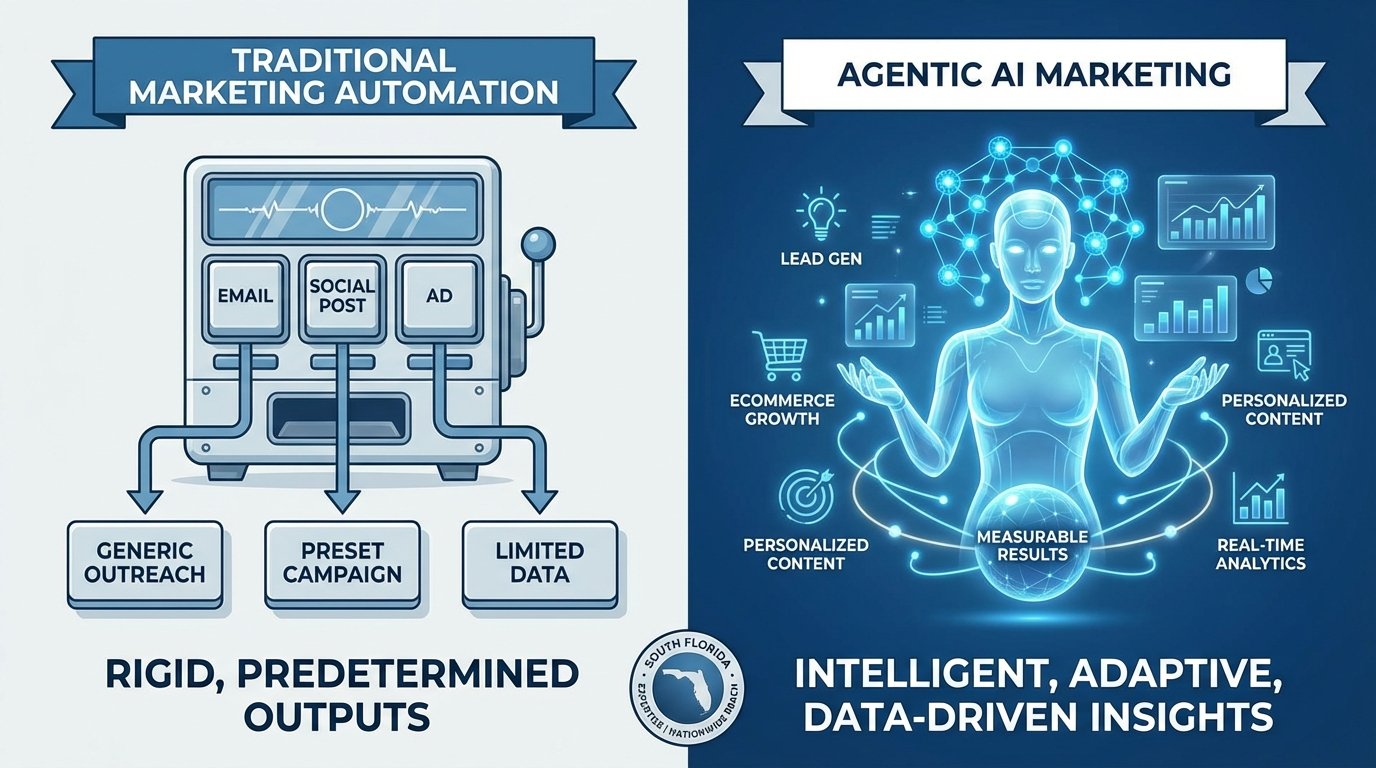
Agentic workflows represent a fundamental shift from basic automation. Traditional marketing automation is like a vending machine—you press a button, and it delivers a predetermined result. Agentic AI is more like hiring a skilled marketing assistant who understands your goals, observes what’s working, and adjusts strategy independently.
These AI agents use agentic reasoning to analyze situations, make decisions, and execute tasks without human intervention. They learn from outcomes and continuously improve their performance. For a Boca Raton boutique or a Fort Lauderdale service provider, this means marketing that gets smarter over time rather than remaining static.
The Four Core Capabilities
Autonomous AI agents in marketing possess four essential abilities:
- Perception: They monitor customer behavior, campaign performance, market trends, and competitor activity in real-time
- Decision-making: They evaluate data and choose optimal actions based on your business goals
- Action: They execute marketing tasks like sending emails, posting content, adjusting ad bids, or personalizing website experiences
- Learning: They analyze results and refine their approach continuously
Multi-Agent Systems: Orchestrating Your Marketing Symphony
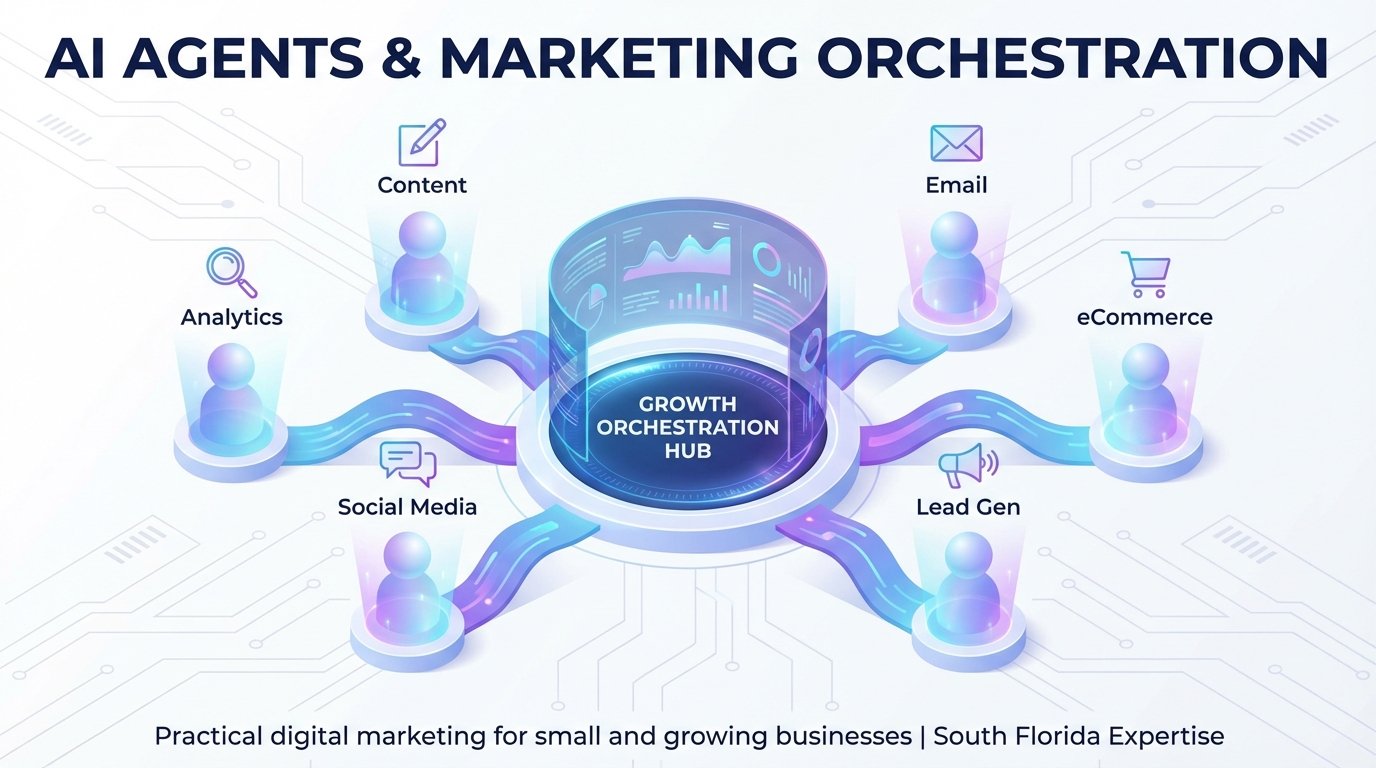
The real power emerges when multiple AI agents work together. Multi-agent systems create specialized teams where each agent handles specific marketing functions while collaborating toward common objectives. This AI orchestration mirrors how a successful marketing agency operates, but at a fraction of the cost.
Consider a Miami e-commerce store selling beachwear. One agent monitors social media conversations about beach activities and upcoming events. Another agent analyzes which products customers view most frequently. A third agent manages email campaigns. A fourth optimizes Google Ads bidding. These agents share insights and coordinate actions—when the social monitoring agent detects increased chatter about an upcoming beach festival, it triggers the email agent to send relevant product recommendations while the ad agent increases bids for festival-related keywords.
Real Results from South Florida Businesses
A Delray Beach dental practice implemented agentic workflows in late 2025 and saw remarkable improvements. Their AI agents identified that appointment reminder emails sent on Tuesday afternoons had 43% higher open rates than Monday mornings. The system automatically adjusted timing across their patient base. Another agent noticed patients who booked teeth whitening often searched for cosmetic procedures six months later, triggering personalized follow-up campaigns. Within three months, patient retention improved by 31% and cosmetic service bookings increased by 47%.
Implementing Agentic Automation in Your Business
Starting with agentic workflows doesn’t require a complete marketing overhaul. Smart small businesses begin with high-impact areas where autonomous decision-making delivers immediate value.
Email Marketing Intelligence
Traditional email automation sends messages based on simple triggers—someone signs up, they receive a welcome series. Agentic automation analyzes individual subscriber behavior to determine optimal send times, subject line styles, content types, and offer structures for each person.
An AI agent might notice that certain customers engage more with educational content while others respond to promotions. It automatically segments audiences and personalizes campaigns without you creating dozens of manual workflows. When a campaign underperforms, the agent tests alternatives and implements improvements immediately rather than waiting for your monthly review.
Content Creation and Distribution
Agentic AI doesn’t just schedule posts—it determines what content to create based on trending topics, audience interests, and business objectives. These systems analyze which blog topics drive the most qualified traffic, what social media formats generate engagement, and which keywords present opportunities.
A Pompano Beach home services company uses AI agents that monitor local community discussions, identify common customer questions, and generate relevant blog post outlines. The agent schedules content creation priorities, suggests optimal publishing times, and distributes finished content across appropriate channels. The business owner approves major decisions but doesn’t micromanage every post.
Customer Journey Optimization
Agentic reasoning excels at managing complex customer journeys. AI agents track individual prospects across touchpoints—website visits, email opens, social media interactions, chat conversations—and determine the next best action for each person.
If someone visits your pricing page three times but doesn’t convert, an agent might trigger a personalized email addressing common objections. If another prospect engages heavily with case studies, the agent surfaces additional success stories. These decisions happen instantly and uniquely for each potential customer, creating personalized experiences that were previously impossible for small businesses.
Choosing the Right Agentic Tools for Small Business
The agentic AI landscape evolved significantly in 2026, with several platforms designed specifically for small business needs. Unlike enterprise solutions requiring technical teams, modern platforms offer user-friendly interfaces while delivering sophisticated autonomous capabilities.
Essential Features to Prioritize
When evaluating agentic workflow platforms, focus on these capabilities:
- No-code setup: You should configure agents through visual interfaces without programming knowledge
- Transparent decision-making: The system should explain why agents take specific actions so you maintain control and understanding
- Integration flexibility: Agents must connect with your existing tools—CRM, email platform, social media, website, and e-commerce system
- Guardrails and approvals: You should set boundaries on agent autonomy, requiring approval for significant decisions if desired
- Performance analytics: Clear reporting on how autonomous decisions impact business results
Budget Considerations
Agentic automation platforms in 2026 typically range from $200 to $1,500 monthly for small businesses, depending on sophistication and scale. While this represents an investment, consider the alternative—hiring additional marketing staff costs significantly more and doesn’t provide 24/7 operation or instant scalability.
Start with one or two high-value applications rather than attempting complete marketing transformation immediately. Many South Florida businesses begin with email and customer journey agents, then expand into content, advertising, and analytics as they experience results.
Maintaining the Human Touch
The biggest concern small business owners express about agentic AI is losing personal connection with customers. This fear is understandable but misplaced when systems are implemented thoughtfully.
Autonomous AI actually enhances personalization by enabling individual attention at scale. Instead of sending the same monthly newsletter to everyone, agentic systems deliver relevant content based on each customer’s interests and behaviors. Rather than generic responses, AI agents can reference specific customer history and preferences in communications.
A West Palm Beach boutique hotel uses AI agents to personalize guest communications while maintaining their warm, personal brand voice. The system remembers past stays, preferences, and special occasions, mentioning details that create genuine connection. Guests consistently comment on feeling remembered and valued—not realizing AI agents help orchestrate these personalized touches.
The key is setting clear brand guidelines for your agents. Define your tone, values, and communication style. Specify when human review is required—perhaps before publishing major content pieces or addressing customer complaints. Agentic AI handles routine tasks and preliminary decision-making, freeing you to focus on high-touch customer relationships and strategic thinking.
Measuring Success with Agentic Workflows
Autonomous systems generate substantial data, but South Florida business owners should focus on metrics that connect directly to revenue and growth.
Key Performance Indicators
Track these essential metrics to evaluate agentic automation impact:
- Lead quality improvement: Are autonomous agents generating more qualified prospects who actually convert?
- Conversion rate changes: How do personalized customer journeys impact purchase rates?
- Time savings: How many hours weekly do you reclaim from routine marketing tasks?
- Customer lifetime value: Do personalized retention campaigns increase repeat business?
- Cost per acquisition: Does intelligent ad optimization reduce what you spend to acquire customers?
A Coral Springs accounting firm tracked these metrics after implementing agentic workflows in January 2026. Within four months, their cost per lead decreased by 38%, consultation booking rates improved by 52%, and the owner reclaimed approximately 12 hours weekly previously spent on marketing coordination. Most importantly, new client acquisition increased by 67% without proportional increases in marketing spending.
Common Mistakes to Avoid
Small businesses new to agentic automation often stumble in predictable ways. Avoid these pitfalls:
Excessive autonomy too quickly: Start with agents handling lower-risk decisions while you build confidence in their performance. Gradually expand autonomy as you observe results.
Insufficient data foundation: Agentic reasoning requires quality data. Ensure your CRM, website analytics, and customer information are organized before implementing autonomous systems.
Ignoring agent decisions: Review what your AI agents are doing regularly. These check-ins help you understand their logic, catch potential issues, and identify optimization opportunities.
Neglecting strategy: Autonomous execution doesn’t replace strategic thinking. You still define goals, target audiences, and brand positioning—agents optimize execution within your strategic framework.
The Future of Small Business Marketing
Agentic AI workflows represent competitive necessity rather than optional innovation in 2026. South Florida businesses competing for local customers need marketing sophistication that traditionally required agency partnerships or in-house teams. Autonomous AI agents deliver that sophistication accessibly and affordably.
The technology will continue advancing rapidly. Expect agents to become more conversational, capable of explaining their reasoning in plain language. Multi-agent systems will coordinate more seamlessly across channels. Integration with emerging platforms will happen automatically. Early adopters who implement agentic workflows now will refine their systems while competitors are still managing marketing manually.
Getting Started with Confidence
Implementing agentic automation doesn’t mean abandoning what makes your business special. These systems amplify your marketing effectiveness while preserving—even enhancing—personal customer relationships that drive small business success.
Start by identifying your most time-consuming, repetitive marketing tasks. Email nurturing, social media scheduling, and ad bid management are ideal initial applications. Choose platforms with strong support and training resources. Set clear objectives and success metrics before launching agents. Review performance weekly initially, then monthly as systems prove reliable.
The South Florida business landscape is increasingly competitive. Customers expect personalized experiences regardless of company size. Agentic AI workflows level the playing field, giving your business enterprise-level marketing capabilities while maintaining the authentic, personal approach that distinguishes small businesses from corporate competitors.
Ready to transform your marketing from a constant struggle into a growth engine? UltraWeb Marketing specializes in helping South Florida businesses implement agentic AI workflows that deliver measurable results without overwhelming complexity. We’ll assess your current marketing, identify high-impact opportunities for autonomous agents, and guide implementation with the personal attention you deserve. Contact us today for a free consultation and discover how agentic automation can scale your marketing while reclaiming your time.
Frequently Asked Questions
What’s the difference between marketing automation and agentic AI?
Traditional marketing automation follows fixed rules you program—if someone does X, send Y. Agentic AI makes independent decisions based on goals you set. It analyzes situations, chooses optimal actions, learns from results, and adjusts strategy without your constant input. Think of automation as a recipe you follow exactly versus an experienced chef who adapts based on available ingredients and diner preferences.
Is agentic AI too expensive for small businesses?
Agentic AI platforms designed for small businesses typically cost between $200-$1,500 monthly in 2026, far less than hiring marketing staff. Most businesses see positive ROI within 90 days through improved conversion rates, reduced ad spending, and time savings. Start with targeted applications in high-impact areas rather than comprehensive implementation to manage initial investment.
Will AI agents make my marketing feel impersonal?
Properly configured agentic AI actually increases personalization by enabling individual attention at scale. Agents remember customer preferences, tailor communications to specific interests, and deliver relevant content based on behavior. You maintain control over brand voice and values while AI handles personalization logistics that would be impossible manually.
How long does it take to see results from agentic workflows?
Most South Florida businesses observe measurable improvements within 30-60 days of implementing agentic workflows. Early wins typically include better email engagement, improved ad performance, and time savings. More substantial impacts like increased conversion rates and higher customer lifetime value become evident over 90-120 days as agents accumulate learning and refine strategies.
Do I need technical skills to use agentic AI?
Modern agentic platforms designed for small businesses require no coding or technical expertise. You configure agents through visual interfaces, setting goals and parameters in plain language. The AI handles complex decision-making behind the scenes. However, partnering with a knowledgeable marketing agency like UltraWeb can accelerate implementation and optimize results significantly.