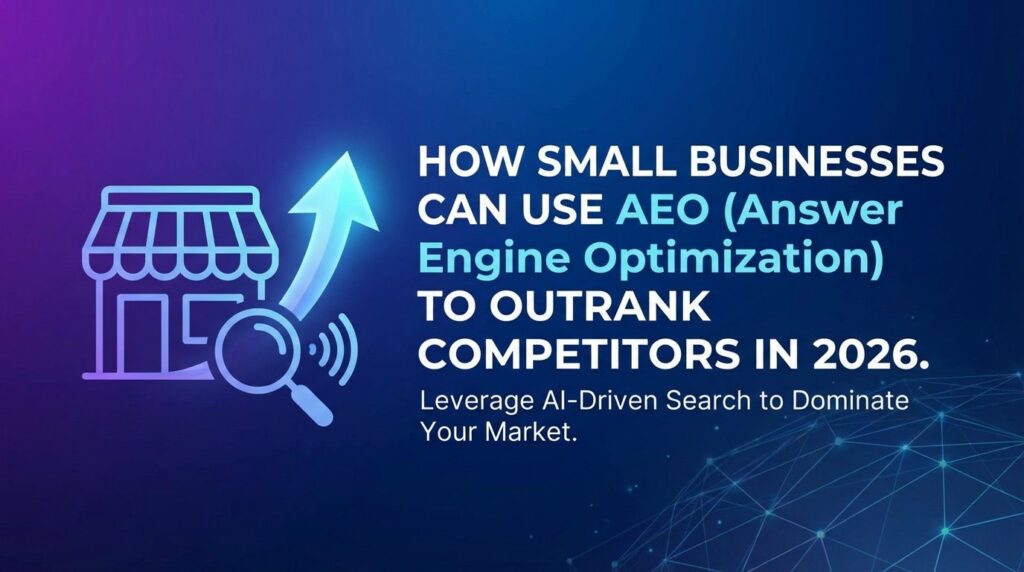
If you’ve been focusing all your efforts on traditional SEO, you might be missing a critical shift happening right now in how people find businesses online. In 2026, answer engines like ChatGPT, Google’s AI Overviews, Perplexity, and voice assistants are answering customer questions directly—without sending them to traditional search results. For small businesses in South Florida and beyond, this means one thing: if your content isn’t optimized for these AI-powered systems, you’re invisible to a growing segment of potential customers.
Answer Engine Optimization (AEO) is the next evolution of search engine optimization, and it’s leveling the playing field for small businesses willing to adapt. While your competitors are still chasing traditional Google ranking optimization tactics from five years ago, you can leapfrog them by understanding how AI retrieves and presents information. Let’s explore exactly how to make AEO work for your business.
What Is Answer Engine Optimization and Why Does It Matter?
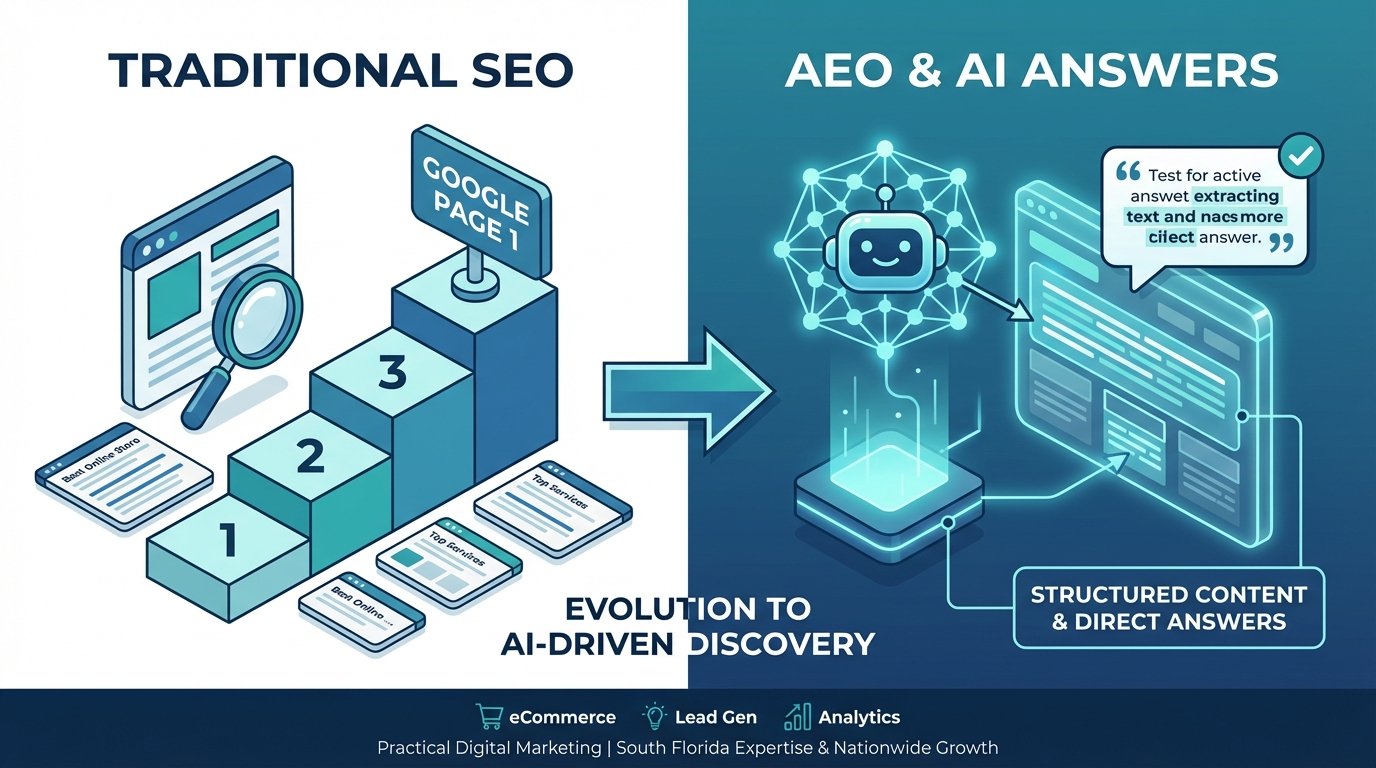
Answer Engine Optimization is the practice of structuring your content so AI systems can easily find, understand, and cite your information when answering user questions. Unlike traditional SEO where success meant ranking on page one of Google, AEO success means being the source that ChatGPT quotes, the business Alexa recommends, or the answer featured in Google’s AI Overview.
Think about how your customers search today. Instead of typing “plumber Miami Beach,” they’re asking conversational questions like “Who’s the best emergency plumber near me that can come tonight?” or “How much does it cost to fix a leaking pipe in South Florida?” Answer engines are designed to respond to these natural language queries with direct, conversational answers—and they pull that information from websites optimized for this purpose.
For small businesses competing against larger companies with bigger marketing budgets, this shift is actually good news. Answer engines prioritize quality, relevance, and trustworthiness over domain age or backlink quantity. A well-optimized local business website can outperform a national competitor if your content better answers the specific question being asked.
The Key Differences Between Traditional SEO and AEO
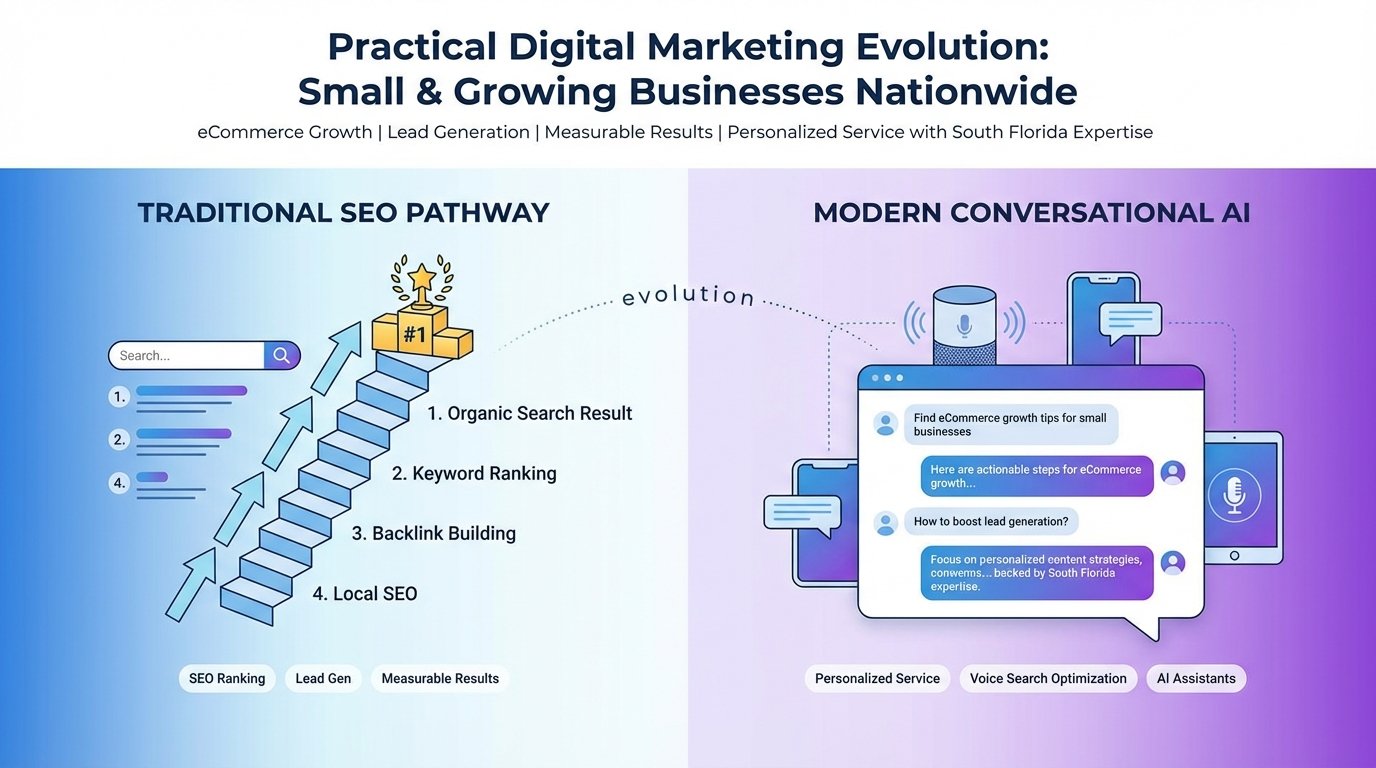
While search engine optimization and AEO share common foundations, understanding their differences helps you develop a winning strategy for 2026.
Traditional SEO Focuses on Rankings
Traditional SEO aims to get your website onto the first page of search results for specific keywords. Success is measured by your position—ranking number one for “local seo services” means more clicks than ranking fifth.
AEO Focuses on Being the Answer
AEO aims to make your content the source that AI systems reference when answering questions. Instead of showing ten blue links, answer engines provide one synthesized response, often citing one or two primary sources. Your goal is to be that cited source.
Different Content Structures
Traditional SEO content often focuses on keyword density and strategic placement. AEO content prioritizes clear, direct answers formatted in ways that AI can easily extract—think structured data, FAQ sections, concise definitions, and conversational language.
Practical AEO Strategies for Small Businesses
Now let’s get into actionable tactics you can implement immediately to optimize for answer engines and outrank your competitors.
Answer Questions Directly and Immediately
AI systems favor content that answers questions quickly and clearly. If someone asks “How long does custom embroidery take?” and lands on your page, the answer should appear in the first paragraph—not after three paragraphs of company history.
Structure your content with the answer first, then provide supporting details, examples, and context. This “inverted pyramid” approach works perfectly for both human readers who want quick answers and AI systems extracting information.
A South Florida HVAC company we work with restructured their service pages using this approach. Instead of starting with “ABC Cooling has been serving Miami for 20 years,” they now lead with “Most AC repairs in South Florida take 1-3 hours and cost between $150-$400 depending on the issue.” Their visibility in AI-generated answers increased significantly, leading to 40% more service calls.
Create Comprehensive FAQ Sections
FAQ sections are gold for AEO. They naturally match the question-and-answer format that AI systems love. Create detailed FAQ sections that address real questions your customers ask.
Don’t just guess at questions—use actual customer inquiries from emails, phone calls, and social media. Questions like “Do you serve Palm Beach County?” or “What’s included in your small business SEO packages?” are perfect FAQ material.
Keep answers concise but complete—typically 40-100 words per answer. Provide enough detail to be helpful without rambling. This length works well for both featured snippets and AI-generated responses.
Optimize for Conversational Keywords and Natural Language
People interact with AI systems conversationally, not with choppy keywords. They say “What’s the best Italian restaurant in Fort Lauderdale with outdoor seating?” rather than typing “Italian restaurant Fort Lauderdale outdoor.”
Write your content using natural, conversational language that mirrors how people actually speak. Include long-tail keyword phrases that sound like real questions. This approach serves double duty—it’s better for AEO and more engaging for human readers.
Implement Structured Data Markup
Structured data helps AI systems understand your content’s context and meaning. While technical implementation requires some expertise, the payoff is substantial. Schema markup tells answer engines exactly what your content is about—whether it’s a service, product, FAQ, how-to guide, or business location.
For local businesses, LocalBusiness schema is particularly valuable. It provides AI systems with your business name, address, phone number, hours, services, and service area in a format they can easily process and reference.
Build Topical Authority in Your Niche
Answer engines prioritize authoritative sources. Instead of creating thin content across dozens of topics, go deep on subjects directly related to your business.
A boutique fitness studio in Boca Raton focused their content strategy on comprehensive articles about specific workout methods, nutrition for their target demographic, and detailed guides about achieving specific fitness goals. Rather than publishing daily short posts about general fitness, they created fewer but more substantial pieces. Within four months, they became the source AI systems regularly cited for questions about their specialty areas, driving a 65% increase in new member inquiries.
Prioritize E-E-A-T Principles
Google’s E-E-A-T framework (Experience, Expertise, Authority, Trust) is equally important for AEO. AI systems are trained to prioritize credible sources, so demonstrate your qualifications clearly.
Include author credentials where relevant, showcase customer testimonials and reviews, display industry certifications, and provide verifiable contact information. These trust signals help AI systems feel confident citing your content as reliable.
Local AEO: A Game-Changer for South Florida Businesses
For small businesses serving specific geographic areas, local AEO offers tremendous opportunity. When someone asks an AI assistant “Who can repair my pool equipment in Coral Springs?” you want to be the recommended answer.
Optimize your content with location-specific information. Don’t just say you serve South Florida—specify cities, neighborhoods, and service areas explicitly. Create location pages that answer common questions specific to each area you serve.
For example, instead of generic content about your services, create pages like “Emergency Locksmith Services in Delray Beach: Response Times and Pricing” or “Wedding Catering in Miami Beach: Venue-Specific Guidelines and Packages.”
Claim and optimize your Google Business Profile completely. AI systems often pull local business information from Google’s knowledge graph, which is heavily influenced by your Business Profile data. Ensure your profile includes comprehensive information, regular updates, and responses to reviews.
Measuring AEO Success
Unlike traditional google ranking optimization where you can check your position daily, measuring AEO success requires different metrics.
Monitor direct traffic increases, which often indicate people finding you through AI recommendations. Track branded search volume—when AI systems mention your business by name, people often search directly for you afterward. Pay attention to the questions people ask when they contact you; if they reference specific information from your website, that’s a sign AI systems are surfacing your content.
Use tools that track featured snippet appearances and monitor whether your content appears in Google’s AI Overviews. While not perfect, these provide indicators of AEO performance.
Most importantly, track actual business results—leads, calls, form submissions, and sales. A local home services company we work with saw a 50% increase in qualified leads within six months of implementing AEO strategies, even though their traditional search rankings remained relatively stable.
Common AEO Mistakes to Avoid
Many small businesses make these mistakes when starting with AEO:
- Over-optimizing for keywords: Stuffing keywords makes content harder for AI to process naturally
- Burying important information: Putting answers at the end of long articles reduces your chance of being cited
- Ignoring mobile optimization: Most voice searches happen on mobile devices
- Creating thin content: Brief, surface-level content rarely gets selected as an authoritative answer
- Neglecting content updates: AI systems favor current, updated information over outdated content
Getting Started with AEO Today
You don’t need to overhaul your entire website overnight. Start with these manageable steps:
First, identify the ten most common questions customers ask about your products or services. Create or update content that answers these questions clearly and directly.
Second, audit your existing high-performing content. Add FAQ sections, restructure to put answers first, and make language more conversational.
Third, ensure your local business information is consistent and comprehensive across your website, Google Business Profile, and other online directories.
Fourth, create one piece of substantial, authoritative content per month that thoroughly addresses a topic relevant to your business. Quality beats quantity for AEO.
Why Partner with AEO Experts
While these strategies are accessible to any business owner, implementing them effectively alongside all your other responsibilities can be overwhelming. This is where partnering with a digital marketing team that understands both traditional search engine optimization and emerging AEO becomes valuable.
At UltraWeb Marketing, we’ve helped dozens of South Florida small businesses adapt to this new landscape. We combine technical expertise with a personal touch—you’re not just another account number. We take time to understand your specific business, your customers, and your goals, then create strategies that deliver measurable results.
Our approach integrates traditional local seo services with cutting-edge AEO techniques, ensuring you’re positioned to capture customers regardless of how they search. We handle the technical complexity while you focus on running your business.
Ready to get ahead of your competitors with AEO? Contact UltraWeb Marketing today for a free consultation. We’ll analyze your current online presence, identify opportunities specific to your business, and show you exactly how AEO can drive more leads and sales in 2026. Let’s make your business the answer customers are looking for.
Frequently Asked Questions
What is the main difference between SEO and AEO?
SEO focuses on ranking in traditional search engine results pages, while AEO focuses on having your content selected as the answer that AI systems and answer engines provide directly to users. AEO requires more conversational, structured content that AI can easily extract and cite.
How long does it take to see results from AEO efforts?
Most businesses see initial results within 2-4 months of implementing AEO strategies, though this varies based on competition and content quality. Unlike traditional SEO which can take 6-12 months, AEO often delivers faster visibility because AI systems can discover and utilize new authoritative content more quickly.
Can small businesses really compete with larger companies using AEO?
Absolutely. AEO levels the playing field because answer engines prioritize relevance, clarity, and authority over domain age or company size. A small business with well-structured, helpful content answering specific questions can outperform a larger competitor with generic content.
Do I still need traditional SEO if I’m doing AEO?
Yes. AEO and traditional SEO work together. Many people still use traditional search, and strong SEO foundations help with AEO as well. The best strategy incorporates both approaches to capture customers across all search methods.
What types of content work best for AEO?
FAQ pages, how-to guides, detailed service descriptions, comparison articles, and content that directly answers common questions perform best for AEO. Content should be conversational, well-structured, and provide clear, authoritative answers quickly.