If you’re running a small business in South Florida, you’ve probably experimented with AI tools by now. Maybe you’ve tried ChatGPT for writing emails, used an AI image generator for social media posts, or tested an automated chatbot on your website. These tools can be helpful, but here’s the reality: using individual AI tools is like having a toolbox full of hammers when what you really need is a construction crew that works together.
The game-changer for small businesses in 2026 isn’t just using AI tools—it’s implementing AI agents that work autonomously and collaboratively to handle complex business processes. This shift from simple automation to agentic automation is transforming how smart business owners compete, and if you’re not paying attention, you’re already falling behind.
Understanding the Difference: AI Tools vs. AI Agents
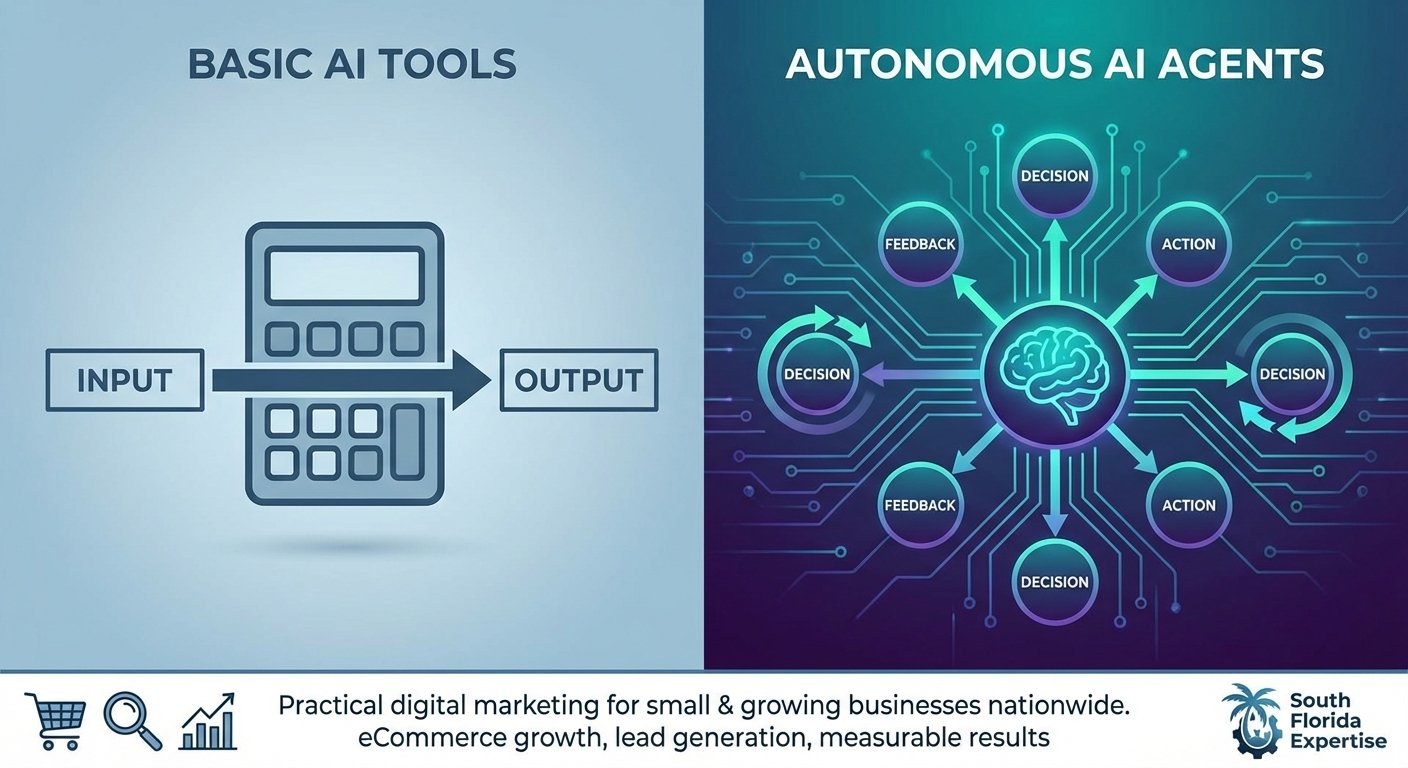
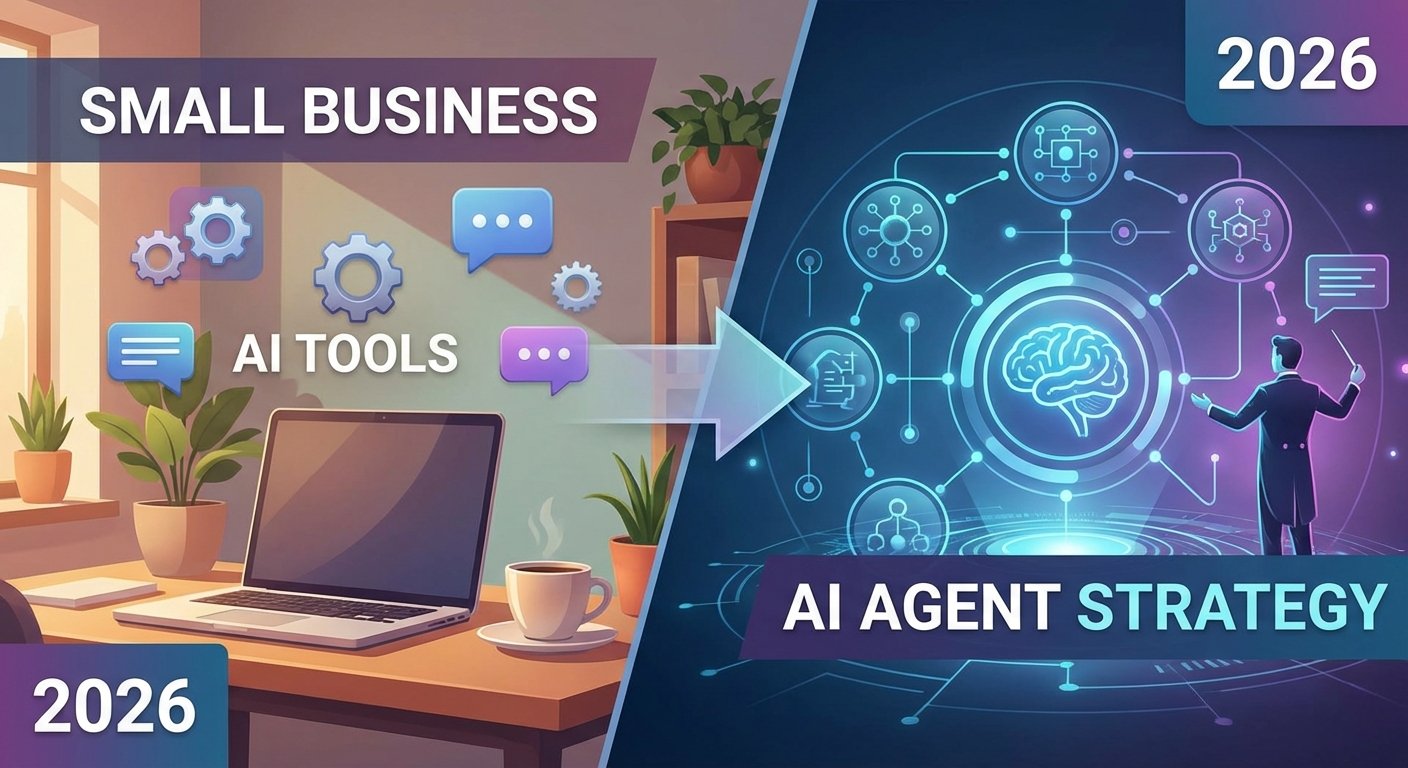
Let’s clear up the confusion first. An AI tool is like a calculator—you input something, it gives you an output, and it waits for your next instruction. AI agents, on the other hand, are fundamentally different. They’re autonomous systems that can make decisions, take actions, learn from results, and work toward goals without constant human supervision.
Think of it this way: An AI tool might help you write a single email to a customer. An AI agent can monitor all your customer inquiries, categorize them by urgency and type, draft appropriate responses, learn which responses work best, follow up automatically, and escalate complex issues to your team—all while you’re focusing on running your business.
This capability is called agentic reasoning—the ability for AI systems to plan, make decisions, and adjust their approach based on outcomes. It’s the difference between a helpful assistant and a true business partner.
What Makes AI Agents Essential for Small Businesses in 2026
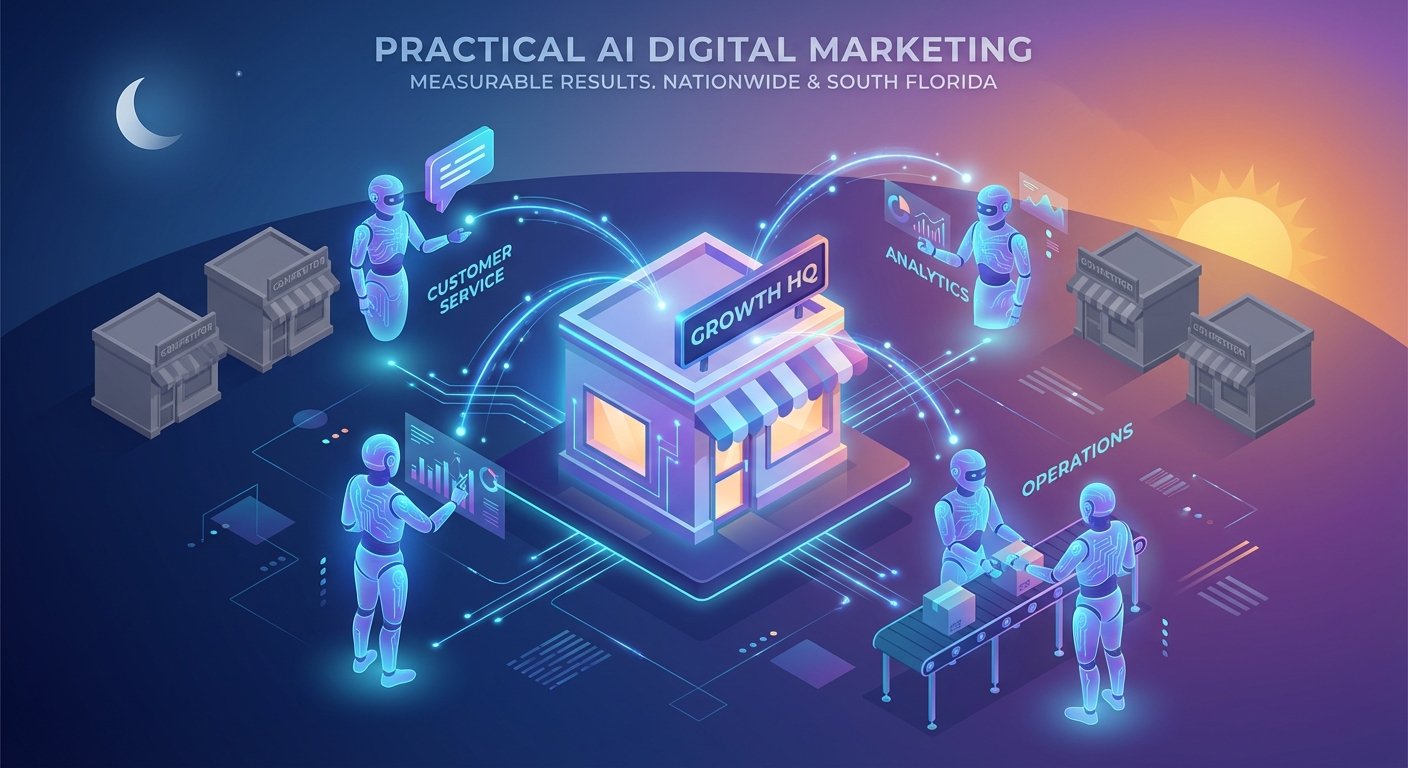
The competitive landscape has shifted dramatically. Your competitors aren’t just using better software anymore—they’re deploying intelligent systems that work 24/7, make data-driven decisions in real-time, and continuously improve their performance. Here’s why AI agents have become critical:
The Labor Market Reality
In South Florida’s tight labor market, finding reliable employees for routine tasks has become increasingly expensive and challenging. The average cost to hire and train someone for customer service, data entry, or basic administrative work can easily exceed $5,000—and that’s before paying their salary. AI agents can handle these responsibilities at a fraction of the cost while never calling in sick or taking vacation.
Customer Expectations Have Evolved
Your customers now expect instant responses, personalized experiences, and seamless interactions across every touchpoint. A coffee shop owner in Boca Raton recently shared that customers were frustrated when their loyalty program required manual check-ins. By implementing an AI agent system, the shop now automatically tracks purchases, sends personalized offers based on buying patterns, and adjusts promotions in real-time based on inventory levels—all without any staff involvement.
Multi-Agent Systems Create Competitive Advantages
The real power emerges when you deploy multiple specialized AI agents that communicate and collaborate. This approach, called multi-agent systems, allows you to create sophisticated agentic workflows that handle complex business processes end-to-end.
For example, a Fort Lauderdale e-commerce store selling boat accessories uses three coordinated agents: one monitors competitor pricing and adjusts their prices accordingly, another manages inventory and automatically reorders products based on sales trends and seasonal patterns, and a third handles customer communications from inquiry through post-purchase follow-up. These agents share information and coordinate their actions—when the inventory agent notices low stock on a popular item, it communicates with the pricing agent to adjust promotions and with the customer service agent to set proper delivery expectations.
Practical AI Agent Applications for Small Businesses
Let’s get specific about how agentic automation can transform your operations:
Customer Relationship Management
An AI agent doesn’t just store customer data—it actively manages relationships. It can identify customers who haven’t purchased in 60 days and create personalized win-back campaigns, recognize high-value customers and alert you to provide special attention, and even predict which customers are at risk of churning based on behavior patterns.
A Miami-based HVAC company implemented an AI agent for customer relationship management and saw a 34% increase in repeat business within four months. The agent automatically schedules maintenance reminders, follows up after service calls, identifies upsell opportunities based on equipment age, and even adjusts communication timing based on when individual customers are most likely to respond.
Content Creation and Marketing
Autonomous AI agents can manage your entire content calendar—researching trending topics in your industry, creating blog posts and social media content, optimizing for SEO, scheduling posts for optimal engagement times, and analyzing performance to refine future content. This goes far beyond using ChatGPT to write occasional posts; it’s a complete system that manages your content strategy with minimal oversight.
Operations and Workflow Automation
This is where AI orchestration becomes invaluable. Instead of handling tasks individually, you create interconnected systems where agents manage entire processes. A West Palm Beach dental practice uses this approach to coordinate patient scheduling, insurance verification, appointment reminders, post-visit follow-ups, and review requests. Each function is handled by a specialized agent, but they all work together as a cohesive system.
Financial Management and Forecasting
AI agents can monitor your cash flow, categorize expenses, identify unusual spending patterns, predict future revenue based on historical data and current trends, and even suggest budget adjustments. A small business automation strategy that includes financial oversight can prevent problems before they become critical.
Building Your AI Agent Strategy: A Practical Roadmap
You don’t need to transform your entire business overnight. Here’s how to approach implementing AI agents strategically:
Step 1: Identify High-Impact Repetitive Processes
Look for tasks that consume significant time, follow predictable patterns, and don’t require complex human judgment. Common examples include initial customer inquiries, appointment scheduling, invoice processing, basic data entry, social media posting, and inventory monitoring.
Step 2: Start with a Single Agent
Choose one process and implement an AI agent to handle it completely. This allows you to learn how these systems work, understand their limitations, and build confidence before expanding. Many South Florida business owners start with customer service or email management because the time savings are immediately visible.
Step 3: Measure and Optimize
Track specific metrics: time saved, error reduction, customer satisfaction, response speed, and cost per transaction. Use these insights to refine your agent’s performance. The beauty of autonomous AI is that it learns and improves, but you need to establish clear success metrics.
Step 4: Expand to Multi-Agent Systems
Once you’re comfortable, add complementary agents that can work together. This is where agentic workflows create exponential value. Each new agent doesn’t just add its individual contribution—it multiplies the effectiveness of your existing agents through coordination and information sharing.
Step 5: Maintain Human Oversight
AI agents should augment your team, not replace human judgment entirely. Establish clear escalation protocols for complex situations, regularly review agent performance and decision-making, and adjust parameters based on changing business needs. Your role shifts from doing routine tasks to managing and optimizing intelligent systems.
Common Misconceptions About AI Agents
Let’s address some concerns we hear frequently from small business owners:
“This technology is only for big corporations.” Not anymore. The platforms and tools for deploying AI agents have become accessible and affordable for businesses of all sizes. You don’t need a technical team or massive budget—just a clear strategy and willingness to learn.
“My business is too unique for automated agents.” AI agents excel at learning your specific processes and adapting to your unique needs. They’re not one-size-fits-all solutions; they’re customizable systems that reflect your business requirements.
“I’ll lose the personal touch with customers.” When implemented correctly, AI agents enhance personalization. They can remember every customer interaction, preferences, and history—delivering more personalized experiences than humanly possible while freeing your team to focus on high-value personal interactions.
“It’s too complicated to set up.” The technology has matured significantly. Many AI agent platforms now offer user-friendly interfaces and pre-built templates for common business processes. With the right partner, implementation can happen in weeks, not months.
The Cost of Waiting
Every month you delay implementing an AI agent strategy, you’re falling further behind competitors who are already benefiting from these efficiencies. Consider that a single AI agent handling customer inquiries works 24/7/365—that’s equivalent to 4.2 full-time employees in terms of coverage, at a fraction of the cost.
A Delray Beach boutique hotel was losing bookings to competitors because they couldn’t respond to inquiries outside business hours. After implementing an AI agent for initial guest communications, their booking conversion rate increased 28% within two months, generating an additional $47,000 in monthly revenue. The agent cost less than $500 monthly to operate.
Take Action: Start Building Your AI Agent Strategy Today
The businesses that thrive in 2026 and beyond won’t be those with the biggest budgets or largest teams—they’ll be the ones who strategically leverage AI agents to multiply their effectiveness. You don’t need to understand every technical detail or transform your operations overnight. You just need to take the first step.
At UltraWeb Marketing, we’ve helped dozens of South Florida small businesses implement practical AI agent strategies that deliver measurable results. We understand the challenges you face because we work exclusively with small to medium businesses like yours—we provide the expertise and personal attention you need without corporate-level complexity.
Ready to explore how AI agents can transform your business? Let’s have a conversation about your specific challenges and opportunities. Contact UltraWeb Marketing today for a free consultation, and we’ll show you exactly how an AI agent strategy can increase your leads, improve your customer experience, and boost your bottom line—with concrete numbers specific to your business.
Frequently Asked Questions
What’s the difference between AI tools and AI agents?
AI tools require human input for each task and provide outputs based on that input. AI agents are autonomous systems that can make decisions, take actions, learn from results, and work toward goals without constant supervision. Think of AI tools as individual helpers and AI agents as intelligent team members who can manage entire processes independently.
How much does it cost to implement AI agents for a small business?
Costs vary based on complexity and scope, but many small businesses start with basic AI agent implementations for $300-$800 monthly. This is significantly less expensive than hiring additional staff for the same functions. Most businesses see positive ROI within the first 90 days through time savings and increased efficiency.
Do I need technical expertise to use AI agents?
No. Modern AI agent platforms are designed for business owners, not developers. With the right implementation partner, you can deploy and manage AI agents without any technical background. The focus is on defining your business processes and goals—the technology handles the complex parts.
Can AI agents work with my existing software and systems?
Yes. Most AI agent platforms integrate with popular business tools like CRM systems, email platforms, accounting software, and e-commerce platforms. Integration capabilities have improved dramatically in 2026, making it easier to create connected agentic workflows across your entire business ecosystem.
What’s a multi-agent system and why do I need one?
A multi-agent system uses multiple specialized AI agents that communicate and coordinate to handle complex business processes. You need one because real business challenges rarely exist in isolation—your sales, customer service, inventory, and marketing all affect each other. Multi-agent systems create exponentially more value than individual agents by enabling coordination and information sharing across different business functions.
How long does it take to implement an AI agent strategy?
A basic single-agent implementation typically takes 2-4 weeks from planning to deployment. More comprehensive multi-agent systems might take 6-12 weeks depending on complexity. The key is starting with one high-impact process and expanding systematically rather than trying to automate everything at once.