
Choosing the right platform for your online store can feel like standing at a crossroads with no map. One wrong turn, and you could be stuck with expensive monthly fees, limited customization, or a website that doesn’t grow with your business. If you’re a South Florida business owner ready to launch or upgrade your ecommerce site, you’re probably weighing two major options: Shopify and WooCommerce. Both power millions of successful online stores, but which one is right for YOUR business in 2026?
The truth is, there’s no universal answer. The best platform depends on your technical comfort level, budget, growth plans, and specific business needs. Let’s break down everything you need to know to make an informed decision that will drive real results for your business.
Understanding the Fundamental Difference
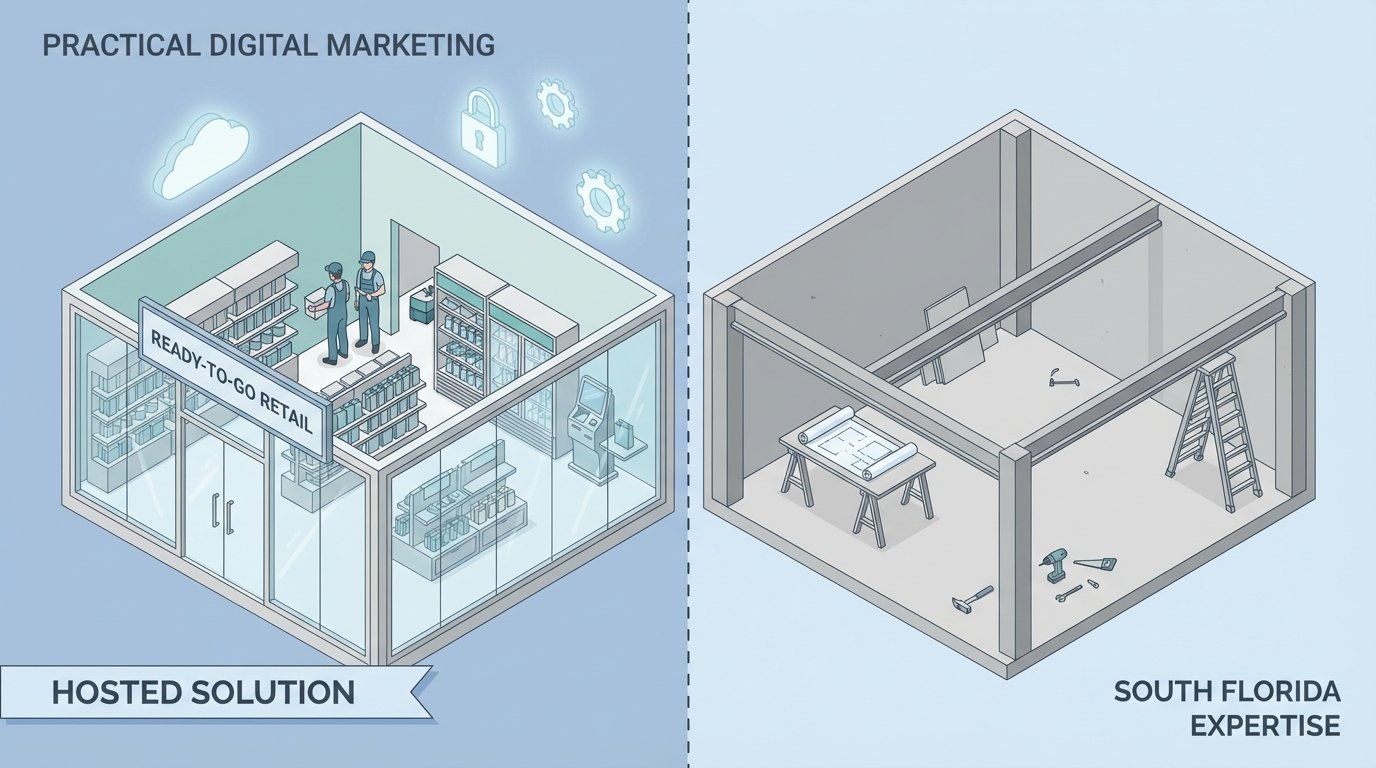
Before diving into features and pricing, you need to understand the core distinction between these platforms. Shopify is a hosted, all-in-one solution—think of it as renting a fully furnished storefront. You pay a monthly fee, and Shopify handles hosting, security, and core technical maintenance. WooCommerce, on the other hand, is a free WordPress plugin that transforms your WordPress website into an online store. You’re responsible for hosting, security, and maintenance, giving you complete control but requiring more technical involvement.
This fundamental difference shapes everything else about how these platforms work, what they cost, and how they’ll serve your business as it grows.
Shopify: The Turnkey Ecommerce Solution
Shopify has become synonymous with ecommerce website development for good reason. It’s designed specifically for selling products online, and it shows in every aspect of the platform.
What Makes Shopify Stand Out
The biggest advantage of Shopify is simplicity. You can launch a professional-looking online store in days, not weeks or months. The platform includes everything you need out of the box: shopping cart functionality, payment processing, inventory management, and mobile optimization. For business owners who want to focus on products and customers rather than website maintenance, this is incredibly appealing.
Shopify’s app ecosystem is another major strength. Need email marketing? There’s an app. Want to add customer reviews? There’s an app. Looking to integrate with Amazon or Facebook Marketplace? You guessed it—there’s an app. As of 2026, Shopify’s app store includes over 8,000 applications that extend your store’s functionality without requiring custom development.
The platform also excels at point-of-sale integration. If you operate both online and at physical locations around South Florida—perhaps a boutique in Boca Raton and a popup shop in Fort Lauderdale—Shopify’s POS system seamlessly syncs inventory across all channels.
Shopify’s Limitations
The convenience comes with tradeoffs. Monthly fees start at $39 for the Basic plan, but most growing businesses need the $105 Shopify plan or the $399 Advanced plan for better analytics and lower transaction fees. These costs add up quickly, especially when you factor in premium themes ($180-$350) and paid apps ($10-$100 per month each).
Transaction fees are another consideration. Unless you use Shopify Payments, you’ll pay an additional 0.5% to 2% on every sale on top of credit card processing fees. For high-volume stores, these percentages represent significant money.
Customization can also be limiting. While Shopify themes are attractive and functional, making significant design or functionality changes often requires hiring a Shopify developer in South Florida or elsewhere. You’re working within Shopify’s ecosystem and must play by their rules.
WooCommerce: The Flexible WordPress Option
WooCommerce powers approximately 39% of all online stores globally in 2026, making it the most popular ecommerce platform by market share. Its success stems from flexibility and control.
The WooCommerce Advantage
The plugin itself is free, which immediately appeals to budget-conscious business owners. You’ll pay for hosting (typically $15-$50 monthly for quality ecommerce hosting), a domain name, and an SSL certificate, but there are no platform fees eating into your margins. You keep every dollar you earn, minus payment processing fees.
Customization possibilities are virtually limitless. Because WooCommerce runs on WordPress—the world’s most popular content management system—you have access to thousands of themes and plugins. Working with professionals experienced in WordPress website design, you can create a truly custom ecommerce solution that matches your brand perfectly and includes exactly the features you need.
Content marketing is another area where WooCommerce shines. WordPress was built for blogging and content creation, making it effortless to maintain a robust blog alongside your store. This is invaluable for SEO and attracting organic traffic. If you plan to educate customers through detailed product guides, recipes, tutorials, or industry insights, WooCommerce’s content capabilities are unmatched.
The platform also offers complete data ownership. Your store, your data, your rules. You can move hosts, change designs, or migrate to another platform without being locked into a proprietary system.
WooCommerce’s Challenges
Freedom comes with responsibility. You’re in charge of security updates, plugin compatibility, and technical troubleshooting. If your site goes down at 2 AM, you need a plan—either technical skills, a maintenance plan with your developer, or reliable support.
The initial setup requires more technical knowledge than Shopify. While WordPress is user-friendly, configuring WooCommerce, selecting and customizing a theme, setting up payment gateways, and optimizing performance involves a learning curve. Many South Florida business owners partner with agencies like UltraWeb Marketing for custom ecommerce solutions that handle the technical heavy lifting while providing ongoing support.
Costs can become unpredictable. While the core plugin is free, premium themes, essential plugins for functionality like advanced shipping or subscription products, and developer time for customization add up. However, you pay for exactly what you need rather than bundled features you’ll never use.
Real-World Performance Comparison
Let’s look at how these platforms serve actual businesses. A Miami-based swimwear boutique launched on Shopify and was selling within a week. The owner, not particularly tech-savvy, appreciated the straightforward dashboard and automatic updates. Within six months, she was generating $15,000 monthly with minimal technical headaches.
Meanwhile, a West Palm Beach specialty coffee roaster chose WooCommerce. They wanted deep integration with their blog featuring brewing guides and origin stories, plus a custom subscription system for monthly coffee deliveries. Their ecommerce web design allowed for unique branding that stood out from competitors. After the initial development investment, their monthly costs were roughly $75 versus the $300+ they would have paid for comparable Shopify functionality.
Both businesses succeeded because they chose platforms aligned with their priorities and capabilities.
Making Your Decision: Key Questions to Ask
The right platform for your business depends on honest answers to these questions:
What’s Your Technical Comfort Level?
If technology intimidates you and you want something that “just works,” Shopify’s simplicity is worth the premium. If you’re comfortable with technology or have a reliable developer partner, WooCommerce’s flexibility offers better long-term value.
What’s Your Budget Structure?
Do you prefer predictable monthly expenses (Shopify) or lower ongoing costs with occasional larger investments for customization (WooCommerce)? Consider your cash flow patterns and growth projections.
How Important Is Customization?
Need a standard online store that looks professional and functions well? Shopify delivers this beautifully. Want a completely unique design or specialized functionality? WooCommerce provides the canvas.
What’s Your Content Strategy?
Planning extensive content marketing with blogs, guides, and resources? WooCommerce’s WordPress foundation is ideal. Focused primarily on product sales with minimal content? Shopify’s streamlined approach works perfectly.
How Fast Will You Grow?
Both platforms scale effectively, but consider costs at different revenue levels. A store doing $500,000 annually pays the same Shopify monthly fee as one doing $50,000, but transaction fees significantly impact margins. With WooCommerce, costs scale more gradually based on actual needs.
The South Florida Advantage: Local Expertise Matters
Whichever platform you choose, working with local online store development experts who understand South Florida’s market makes a tremendous difference. A Shopify developer in South Florida can optimize your store for the unique aspects of our market—seasonal tourism patterns, bilingual shoppers, and local shipping considerations from the Keys to Jupiter.
Similarly, agencies specializing in custom ecommerce solutions understand regional customer behavior and can tailor your WooCommerce site accordingly. They’re accessible for in-person meetings, understand local business challenges, and can respond quickly when you need support.
Our Recommendation
Choose Shopify if you want to launch quickly with minimal technical involvement, prefer predictable monthly costs, and value simplicity over customization. It’s ideal for product-focused businesses that need reliable, straightforward ecommerce functionality.
Choose WooCommerce if you want maximum flexibility, plan significant content marketing, prefer lower ongoing costs, and either have technical skills or a trusted development partner. It’s perfect for businesses that view their website as a long-term investment requiring unique functionality.
Many successful businesses eventually use both—WooCommerce for their main brand website with content and community features, and Shopify for specific product lines or secondary brands that benefit from simplified management.
Frequently Asked Questions
Can I switch from Shopify to WooCommerce or vice versa later?
Yes, migration is possible but involves technical complexity and potential downtime. Your products, customers, and order history can be transferred, though you’ll need to rebuild design elements. It’s better to choose carefully upfront, but switching is an option if your needs change significantly.
Which platform is better for SEO?
WooCommerce generally offers more SEO flexibility because WordPress provides superior content management and optimization capabilities. However, Shopify has improved significantly and handles SEO basics well. For businesses heavily investing in content marketing and organic search, WooCommerce has the edge.
Do I need a developer for either platform?
Shopify can be launched without a developer using built-in themes and apps, though customization requires development skills. WooCommerce typically benefits from professional setup and configuration, though technically-inclined owners can handle it themselves. Long-term, having developer support for either platform ensures optimal performance and quick problem resolution.
Which platform has lower total costs?
WooCommerce typically costs less long-term, especially for high-volume stores, because there are no platform fees or transaction charges. However, Shopify’s all-inclusive pricing can be more economical for very small stores or those requiring minimal customization when you factor in the value of time saved.
Can either platform handle wholesale and retail pricing?
Both platforms support wholesale functionality. Shopify requires apps like Wholesale Club or Bold, while WooCommerce offers plugins like Wholesale Suite. WooCommerce provides more flexibility for complex pricing structures without additional monthly app fees.
Ready to Build Your Online Store?
Choosing between Shopify and WooCommerce is just the first step. Successful ecommerce website development requires strategy, design expertise, and ongoing optimization to convert visitors into customers. Whether you need a streamlined Shopify store that launches quickly or custom ecommerce solutions built on WooCommerce’s flexible foundation, the right partner makes all the difference.
At UltraWeb Marketing, we’ve helped dozens of South Florida businesses launch and grow successful online stores on both platforms. We take time to understand your unique needs, recommend the platform that truly fits your business, and provide the hands-on support that makes ecommerce feel manageable rather than overwhelming.
Ready to discuss which platform is right for your business? Contact UltraWeb Marketing today for a free consultation. Let’s turn your ecommerce vision into a profitable reality that grows your business and delivers measurable results.