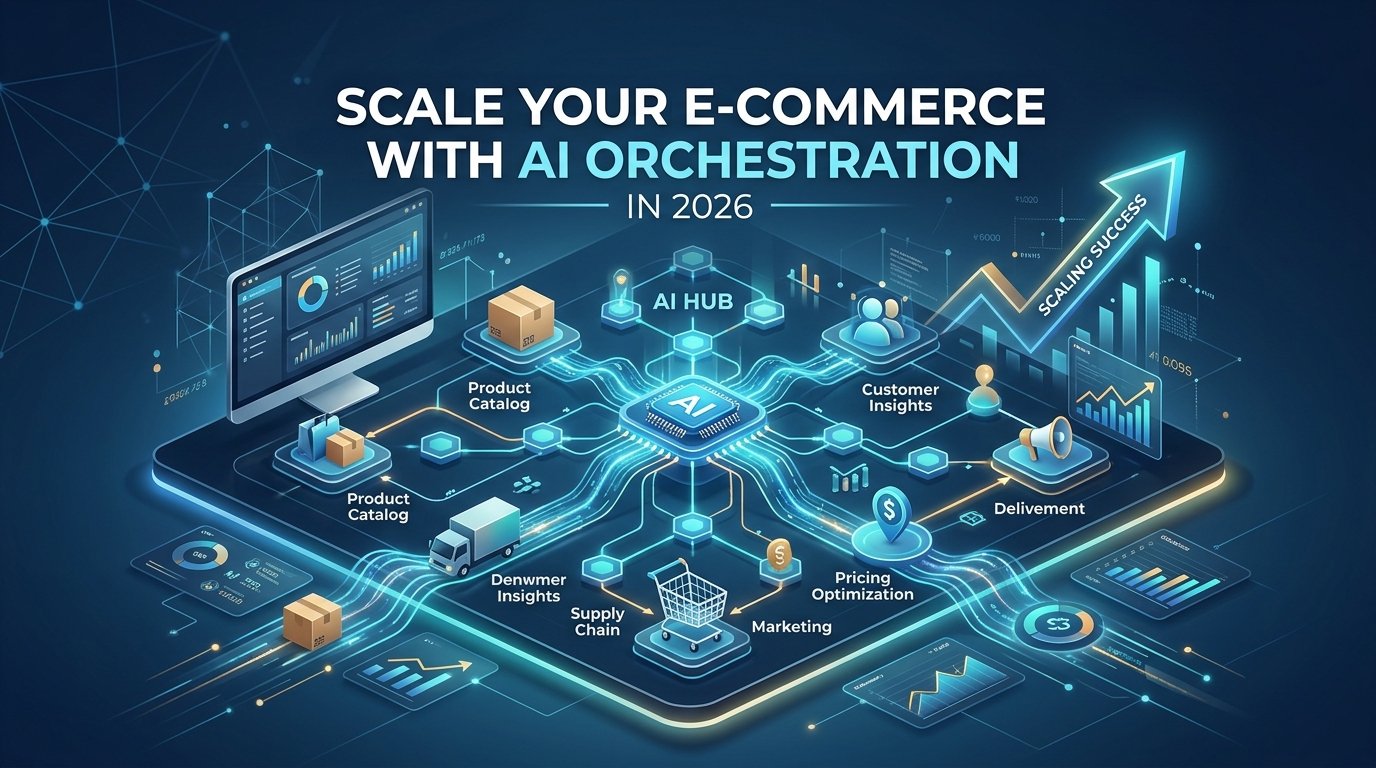
Running an e-commerce business in 2026 means competing against giants with seemingly unlimited resources. You’re juggling inventory management, customer service, marketing campaigns, order fulfillment, and website updates—often with a lean team. What if you could multiply your team’s capabilities without multiplying your payroll? That’s exactly what AI orchestration makes possible.
AI orchestration isn’t just another buzzword. It’s the strategic coordination of multiple AI agents working together to automate complex workflows across your entire e-commerce operation. While a single chatbot might answer customer questions, AI orchestration deploys a coordinated team of specialized AI agents that handle everything from inventory predictions to personalized marketing—all working in harmony to grow your business.
Understanding AI Orchestration for E-commerce
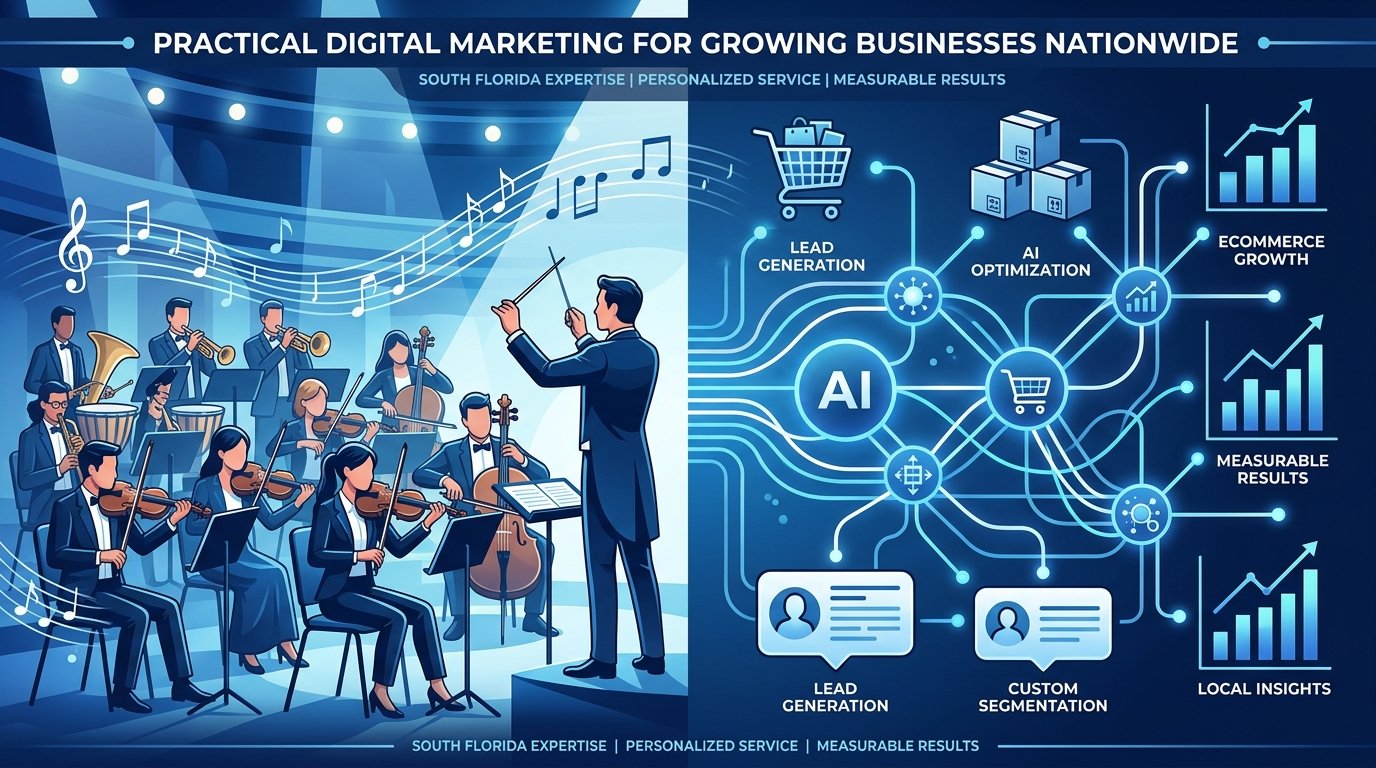
Think of AI orchestration like conducting an orchestra. Each musician plays a different instrument, but the conductor ensures they work together to create beautiful music. In your e-commerce business, AI orchestration coordinates multiple AI agents, each specialized in different tasks, creating a seamless operation that runs more efficiently than any single tool could achieve.
Multi-agent systems represent the evolution of basic automation. Instead of one AI trying to do everything, you deploy specialized autonomous AI agents that excel at specific functions. One agent monitors inventory levels and predicts restock needs. Another analyzes customer behavior and personalizes product recommendations. A third handles dynamic pricing based on demand and competition. The orchestration layer ensures these agents communicate and coordinate their actions.
For South Florida e-commerce businesses, this technology levels the playing field. A boutique in Boca Raton or a specialty retailer in Miami can now deliver the same sophisticated customer experience as national brands—without the enterprise-level budget.
How Multi-Agent Systems Transform E-commerce Operations
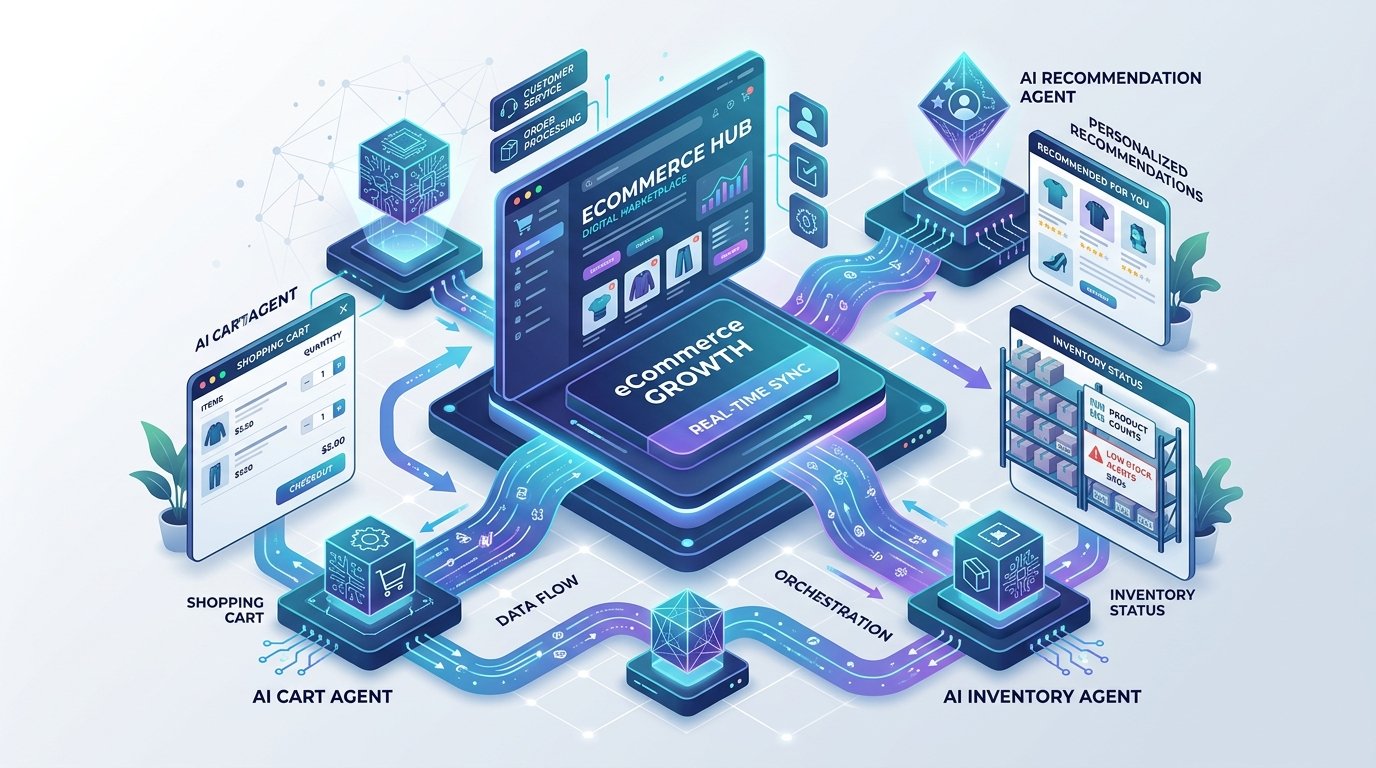
The power of agentic workflows lies in their ability to handle complex processes that would typically require human decision-making at every step. Let’s explore how this works in practice.
Intelligent Customer Journey Management
Traditional e-commerce follows linear paths. A customer visits, browses, maybe purchases. With AI orchestration, every interaction becomes an opportunity for optimization. When someone lands on your online store, multiple AI agents activate simultaneously:
- A personalization agent analyzes browsing history and preferences to customize the homepage
- An engagement agent determines optimal timing for chat offers or promotions
- A conversion agent monitors behavior signals that indicate purchase intent or abandonment risk
- A support agent stands ready to answer questions with context-aware responses
These AI agents don’t work in isolation. If the conversion agent detects abandonment signals, it immediately coordinates with the engagement agent to trigger a timely incentive. If a customer asks the support agent about product specifications, that information feeds back to the personalization agent to refine future recommendations.
Dynamic Inventory and Supply Chain Optimization
One South Florida retailer we work with was constantly struggling with either overstock or stockouts. They implemented an AI orchestration system that changed everything. Their inventory agent now predicts demand patterns by analyzing historical sales, seasonal trends, local events, and even weather forecasts. When it identifies potential stockouts, it automatically coordinates with their ordering agent to generate purchase orders.
The system doesn’t stop there. A pricing agent monitors competitor pricing and adjusts their rates within preset parameters to stay competitive. A marketing agent receives signals about overstock items and automatically creates promotional campaigns to move inventory. This interconnected approach reduced their carrying costs by 34% while increasing product availability to 97%.
Automated Marketing That Actually Works
Generic email blasts don’t cut it anymore. AI orchestration enables truly personalized marketing at scale. Your marketing agents can create campaigns based on individual customer behavior, purchase history, browsing patterns, and predicted needs.
Imagine a customer who bought running shoes from your store three months ago. Your analytics agent knows that running shoes typically need replacement every 400-500 miles. Your engagement agent calculates that based on this customer’s purchase history and activity level, they’re probably due for new shoes. Your content agent generates a personalized email featuring the latest models in their preferred style and size. Your timing agent sends it when this customer typically checks email. Your conversion agent tracks engagement and coordinates follow-up actions.
This level of coordination happens automatically, for every customer, across every touchpoint. It’s marketing that feels personal because it is—powered by AI orchestration instead of manual effort.
Implementing AI Orchestration Without the Overwhelm
The technology sounds complex, but implementation doesn’t have to be. The key is starting strategically with your highest-impact areas.
Start With Your Biggest Pain Point
Don’t try to orchestrate everything at once. Identify where your business loses the most money, time, or customers. For many e-commerce businesses, customer service represents the biggest bottleneck. Implementing an orchestrated customer service system—with agents handling inquiries, order tracking, returns, and escalations—can immediately free up your team for higher-value work.
A Fort Lauderdale-based e-commerce company selling home goods started here. They deployed AI agents to handle routine customer inquiries, which represented 70% of their support tickets. Their human team now focuses exclusively on complex issues and relationship building. Customer satisfaction scores increased because response times dropped from hours to seconds, while their team feels less burned out handling the same repetitive questions.
Integrate With Your Existing Infrastructure
Quality ecommerce website development and online store development in 2026 means building platforms that play well with AI orchestration from the start. Your e-commerce platform, CRM, inventory system, and marketing tools need to communicate seamlessly for AI agents to work their magic.
This is where working with experienced developers who understand both ecommerce web design and AI integration becomes crucial. The technical architecture must support real-time data flow between systems. API connections need to be robust and secure. Data formatting must be consistent so agents can interpret and act on information correctly.
Train Your Team Alongside Your AI
AI orchestration augments your team—it doesn’t replace them. Your employees need to understand how the system works, when to trust AI recommendations, and when human judgment should override automated decisions.
One successful approach involves creating clear escalation protocols. AI agents handle routine tasks autonomously, flag unusual situations for human review, and learn from how your team resolves edge cases. Over time, the system becomes smarter while your team focuses on strategic work that requires creativity, empathy, and complex problem-solving.
Measuring Real Business Impact
AI orchestration isn’t about implementing cool technology—it’s about driving measurable results. Here’s what South Florida e-commerce businesses are seeing:
- Conversion Rate Improvements: Businesses typically see 20-40% increases in conversion rates within the first six months as personalization and timing optimization take effect
- Operational Cost Reductions: Automated workflows reduce labor costs for routine tasks by 50-70%, allowing teams to focus on growth initiatives
- Customer Lifetime Value Growth: Personalized experiences and proactive engagement increase repeat purchases by 30-50%
- Inventory Efficiency: Predictive ordering and dynamic pricing can reduce carrying costs by 25-40% while improving product availability
- Response Time Reductions: Customer inquiries answered in seconds instead of hours, with 24/7 availability
A Miami-based fashion retailer implemented AI orchestration across their entire operation in late 2025. Within six months, they saw their average order value increase by 28%, cart abandonment drop by 31%, and customer service costs decrease by 52%. Most importantly, their small team of five could suddenly operate with the efficiency of a team three times their size.
Common Pitfalls to Avoid
While AI orchestration offers tremendous benefits, implementation challenges exist. Learning from others’ mistakes saves time and money.
Over-Automating Too Quickly
The most common mistake is trying to automate everything immediately. This overwhelms your team, creates integration nightmares, and often delivers poor customer experiences. Start with one or two high-impact workflows, perfect them, then expand gradually.
Neglecting Data Quality
AI agents are only as good as the data they work with. Before implementing orchestration, audit your data. Are product descriptions complete and accurate? Is customer information up to date? Do your systems capture the behavioral data AI needs? Clean, organized data is the foundation of effective AI orchestration.
Setting Unrealistic Expectations
AI orchestration delivers impressive results, but not overnight. Expect a learning period where you’ll fine-tune agent behaviors, adjust workflows, and optimize integrations. Most businesses see meaningful improvements within 60-90 days, with full ROI realized over 6-12 months.
The Future Is Orchestrated
E-commerce in 2026 rewards businesses that can deliver personalized, efficient, responsive experiences at scale. AI orchestration makes this possible for businesses of any size. You don’t need Amazon’s resources to compete with Amazon’s capabilities anymore.
For South Florida e-commerce businesses, this technology represents a genuine competitive advantage. While larger competitors deal with bureaucratic implementation processes, nimble local businesses can deploy AI orchestration quickly and adapt it to their specific needs. The personal touch that makes South Florida businesses special doesn’t disappear—it gets amplified and extended to every customer interaction.
The businesses winning in 2026 aren’t necessarily the biggest or most funded. They’re the ones that strategically leverage AI orchestration to multiply their effectiveness, serve customers better, and operate more efficiently than ever before.
Ready to Scale Smarter?
If you’re running an e-commerce business in South Florida and feeling stretched thin, AI orchestration might be exactly what you need. But implementation matters as much as the technology itself. Working with a team that understands both the technical architecture and the practical realities of running an online store makes the difference between AI that transforms your business and AI that becomes another expensive headache.
At UltraWeb, we specialize in helping South Florida e-commerce businesses implement AI orchestration that actually works. We start by understanding your specific challenges, design orchestrated workflows that address your highest-impact opportunities, and support you through implementation and optimization. We’re not about complicated corporate solutions—we’re about practical technology that drives real results for real businesses.
Want to explore how AI orchestration could scale your e-commerce operation? Let’s talk about your business, your goals, and how multi-agent systems can help you get there. Contact UltraWeb today for a consultation that focuses on your success, not our sales pitch.
Frequently Asked Questions
What exactly is AI orchestration for e-commerce?
AI orchestration is the coordination of multiple specialized AI agents working together to automate and optimize different aspects of your e-commerce business. Instead of one AI tool handling everything, you have multiple AI agents—each excelling at specific tasks like customer service, inventory management, or personalized marketing—all working in harmony under an orchestration layer that ensures they communicate and coordinate effectively.
How much does it cost to implement AI orchestration?
Implementation costs vary widely based on your business size, existing infrastructure, and which workflows you’re orchestrating. Small to medium e-commerce businesses typically invest between $5,000-$25,000 for initial setup, with ongoing costs of $500-$2,000 monthly depending on transaction volume and complexity. Most businesses achieve positive ROI within 6-12 months through increased sales and reduced operational costs.
Do I need to replace my current e-commerce platform?
Not necessarily. Quality AI orchestration systems integrate with most modern e-commerce platforms including Shopify, WooCommerce, BigCommerce, and Magento. The key is ensuring your platform has robust API capabilities for system communication. If your current platform is outdated or lacks integration capabilities, upgrading might be necessary to fully leverage AI orchestration benefits.
Will AI orchestration replace my customer service team?
No, AI orchestration augments your team rather than replacing them. AI agents handle routine, repetitive tasks like order status inquiries, basic product questions, and simple troubleshooting. This frees your human team to focus on complex issues, relationship building, and situations requiring empathy and creative problem-solving. Most businesses find their teams become more satisfied and effective when AI handles the routine work.
How long does it take to see results from AI orchestration?
Most e-commerce businesses notice initial improvements within 30-60 days as AI agents learn your business patterns and customers. Significant measurable results—like increased conversion rates, reduced cart abandonment, and improved operational efficiency—typically appear within 90 days. Full optimization and maximum ROI usually occur over 6-12 months as the system continues learning and workflows are refined.
Is my e-commerce business too small for AI orchestration?
AI orchestration benefits businesses of virtually any size, though the specific workflows you orchestrate may differ. Even small operations with a few hundred monthly orders can benefit from automated customer service, personalized marketing, and inventory optimization. The key is starting with your highest-impact pain points rather than trying to orchestrate everything at once. Scalable solutions exist for businesses at every stage.